
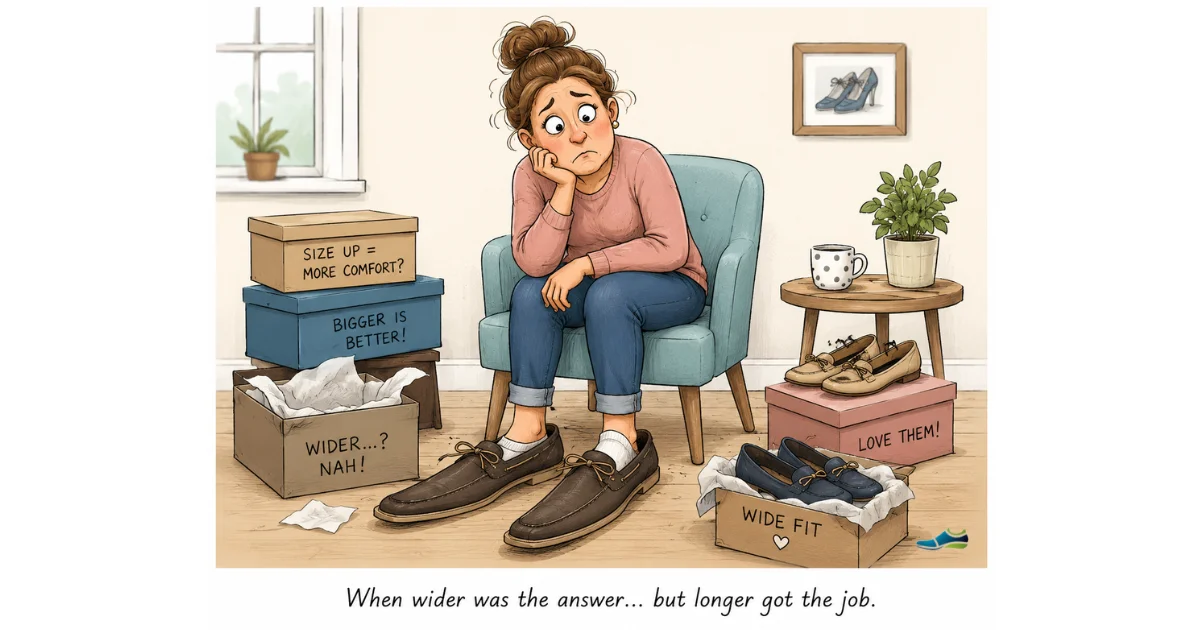
Not by very much. Going up a size mainly gives you extra length, not the extra width most people are actually looking for. If your shoes feel tight across the toes or the sides of your feet, a wider fitting is often a much better answer than a longer shoe.
Now, let’s start with a question.
When did you last kick your shoes off at the end of the day and think, “Wow, that feels so good“?
Not because you’d had a busy day. Not because your feet were tired. But because your shoes had spent the last eight hours squashing your feet. If you remember those days, you’re certainly not on your own.
One of the most common things I hear is, “I’ve gone up a size, but they’re still not comfortable.”
And that’s exactly why I wanted to write this article. because going up a shoe size feels like the obvious answer.
The trouble is, going up a size usually solves the wrong problem.
The Size-Up Mistake
Let’s be honest, if your shoes feel tight, buying the next size up sounds perfectly sensible. Most of us have probably done it at some point.
You try on a bigger pair, walk around the shop for five minutes and think, “That’s much better.”
Then a week later, your heel is slipping, your toes are still cramped and your feet still ache.
So something went wrong?
Here’s a scenario. If your trousers are too tight around the waist, you don’t buy a pair with six-inch longer legs hoping this will help.
No…..You buy a bigger waist.
It sounds ridiculous and obvious when you think about trousers, yet we do exactly the same thing with shoes.
A larger shoe size is mainly longer, and with some styles they’re virtually the same width
If the real problem is width, then basically you’ve simply bought a longer shoe instead of a wider one.
Your Feet Have Two Measurements
This is something that surprises a lot of people.
Every time someone asks your shoe size, they’re only asking half the question, because your feet have two important measurements.
Length, and width.
Yet most of us have spent our entire lives concentrating on the first one and almost ignoring the second.
It’s a bit like having an eye test but they only check one eye. Technically, you’ve had a test…..but you haven’t got the full picture.
Your Feet Probably Haven’t Got Longer
Here’s another myth that’s worth putting to bed.
As adults, our feet can change in both length and width over time. Changes to the arches, ligaments and other tissues can alter foot shape, while arthritis, bunions and swelling can also change the way shoes fit.
Weight changes can also make a difference. In fact, pregnancy can permanently alter foot shape.
So if you’ve been buying the same size for twenty years but suddenly find it uncomfortable, don’t automatically assume that simply going up a size is the answer. Your feet may have changed shape, width or both.
And that’s completely normal.
The Bunion Trap
If you notice a prominent, angular bony protrusion forming right at the base of your big toe, or if your shoes always develop an uncomfortably tight pinch-point across that joint, these physical presentations are highly typical of a progressive bunion deformity.
When people try to manage this changing shape by simply sizing up their standard footwear, the immediate pressure on the joint might feel like it eases a tiny bit at first because the whole upper is longer. However, in my experience living with severe arthritic inflammation and navigating post-surgical foot changes, sizing up is an absolute recipe for disaster.
The widest section of your foot will still suffer under constant squeezing because the shoe chamber itself is still fundamentally too narrow. Managing that shifting volume safely around the house requires a bit of an extra care routine.
While using soft, protective gel sleeves can offer a wonderful bit of immediate cushioning across the bump, choosing footwear engineered from the ground up in a dedicated wide or extra-wide fitting remains the ultimate secret to aligning your foot correctly with the shoe’s natural flex points, keeping your toes splayed naturally and preventing your heel from painfully slipping and chafing against the back counter.
Before long you’re spending money trying to rescue a shoe that never fitted properly in the first place.
That’s the bunion trap, and once you’re in it, it’s surprisingly difficult to escape.
What Actually Changes Between Shoe Sizes?
This is where the confusion starts.
Many people assume that going up a size makes a shoe dramatically wider. Believe me, it doesn’t.
Yes, it becomes a little wider, but nowhere near as much as the increase in length.
That’s why your toes will have acres of space in front of them while the sides of your feet still feel squeezed.
It’s a bit like buying a bigger dining table when the real problem is that your dining room is too narrow.
You’ve changed the wrong dimension.
How Do You Know If Width Is The Problem?
Your feet are usually quite good at telling you, but most people don’t actually listen.
Some common clues include:
- You can’t wait to take your shoes off.
- Your little toe rubs against the side.
- Bunions develop and become sore after a few hours.
- You’re always having to loosen your laces.
- Corns or calluses always appear in the same places.
- Your toes feel as though they’re sitting on top of each other.
- You buy bigger shoes but they’re never quite right.
If several of those sound familiar, there’s a good chance width is the real issue.
Why Wide-Fitting Shoes Feel Different
The first time people wear properly fitting wide shoes, I often hear the same comment.
“I didn’t realise you could get shoes that feel like this.”
That’s because a good wide-fitting shoe isn’t simply a standard shoe that’s been stretched sideways.
It’s designed around a different foot shape and there’s more room where your foot actually needs it.
Your toes can spread naturally, reducing pressure points, and your heel lives where it’s supposed to live.
Everything simply works together better. That’s exactly how shoes should feel.
Wide Fit Doesn’t Mean Everyone Needs Extra Width
It’s important to say this because it’s a common misunderstanding.
Not everybody needs wide-fit shoes. Some people need extra depth rather than extra width, or a different toe box shape. Others simply have shoes that don’t suit the shape of their feet.
The goal isn’t to buy the widest shoe you can find. The goal is to buy the shoe that matches your foot.
There’s a big difference.
Stop Blaming Your Feet
This is probably the one thing I’d love everyone reading this to remember.
Your feet aren’t awkward and they’re not being difficult. They’re simply trying to tell you that something isn’t right.
For years we’ve been of the opinion that our feet are to blame with comments like
“My feet are horrible.“
“I’ve got impossible feet.“
“No shoes fit me.“
Well maybe the problem isn’t your feet at all. Maybe you’ve just never been shown that shoes come in a whole array of different widths.
That’s quite a thought, isn’t it, that all along, the fix has been out there.
Final Thoughts
Buying a bigger shoe is one of the oldest habits in the book. It seems logical. In fact, I’d probably have done exactly the same if nobody had explained the difference to me.
But once you understand that length and width are two completely different measurements, everything starts to make sense.
Instead of asking…“Do I need a bigger size?” Try asking…“Do I actually need more width?”
It sounds like a small change. But it could completely change the way your shoes fit and feel.
And if that’s the case, your feet will probably thank you for it.
Ready to actually shop with this in mind? My Best Wide Fit Shoes for Comfort guide has genuine brand recommendations to start with.
Frequently Asked Questions
Q: Does going up a shoe size make shoes wider?
A: Yes, but only slightly. Most of the increase is in the length of the shoe. If your feet are genuinely wide, choosing a wide-fit version of your usual size is often much more comfortable than simply buying a longer shoe.
Q: How do I know if I need wide-fit shoes?
A: Common signs include cramped toes, rubbing on the little toe, bunion pain, pressure across the forefoot, frequent blisters and always wanting to remove your shoes at every available moment.
Q: Can feet become wider with age?
A: Yes. Ageing, arthritis, pregnancy, weight changes and weakening ligaments can all change the shape of your feet over time, even if the length stays pretty much the same.
Q: Should I buy a bigger shoe if my bunions hurt?
A: Not necessarily. If the pain is caused by a shoe that’s too narrow, moving to a properly measured, wide-fitting shoe may be a better solution than simply increasing the shoe size.
Still wondering whether you actually need wide-fitting shoes? Read our guide to the signs that tell you it’s time to make the switch.
About the Author
Sue Holland writes from lived experience of arthritis, flat feet, chronic swelling and multiple joint replacements. After years of searching for shoes that genuinely fitted, she now shares practical advice to help others find comfortable footwear without wasting money on trial and error.
Medical Disclaimer
This article is based on personal experience and independent research. It should not replace professional medical advice. If you have ongoing foot pain, severe swelling or concerns about your foot health, please seek advice from a qualified healthcare professional.