
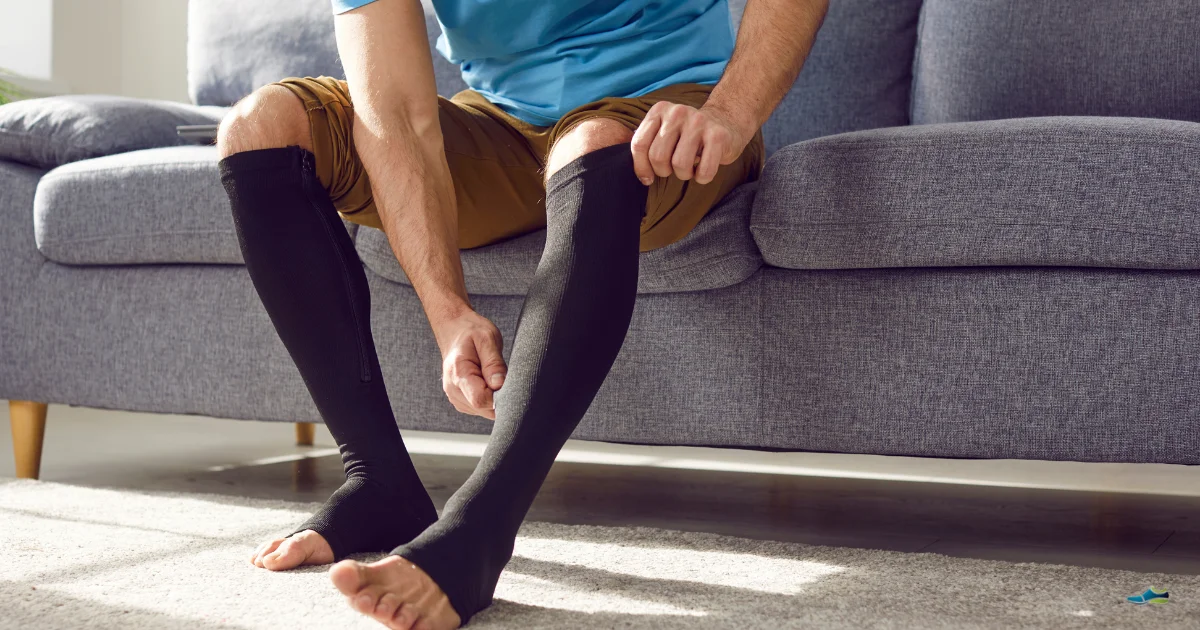
Compression socks apply gentle, graduated pressure to your legs, helping improve circulation, reduce swelling and leave your legs feeling less tired after long days on your feet or sitting for extended periods.
Affiliate disclosure: This article contains affiliate links. If you buy something through one of these links, I may earn a small commission at no extra cost to you.
The important thing is getting the right level of compression. They should feel supportive, not painfully tight, and today’s versions are a world away from the thick, clinical-looking stockings many people remember.
If you’ve been wondering whether compression socks could help you, let’s look at how they work and how to choose a pair that’s comfortable enough to wear every day.
📌 At a Glance
- ✔️ Size compression by ankle & calf measurements — not shoe size.
- ✔️ Pick graduated pressure (e.g., 15–20 mmHg) for everyday support and swelling relief.
- ✔️ Non-binding cuffs + seamless toes prevent hotspots and pressure rings.
- ✔️ Compression should flow, not fight — if it bites or rolls, change size or brand.
If you’re new to compression, it helps to start with Socks & Tights for Swollen Feet (Oedema) — it shows the basics of gentle hold before moving into compression.
Why Compression Works (Without Feeling Medical)
Visually, when our lower legs face a heavy puffiness, a tight pooling of fluid, or a sudden circumference expansion by the end of the day, these changes are highly consistent with significant swelling (oedema).
In my experience, quality graduated compression garments are simply engineered to apply a gentle, measured pressure that is firmest down at the ankle before gradually easing up your leg.
This little bit of extra structural support acts as a beautiful upward pump, assisting your body’s natural movement of blood and lymph fluid back up toward the torso.
The result? Less swelling, faster recovery, and that “light leg” feeling at the end of the day.
Think of it as a gentle helping hand for your circulation rather than a tight bandage.
Old-school versions felt like bandages; new ones are designed for comfort first, using breathable yarns and wide cuffs that stay up without biting.
“If you’re curious about how this helps with pain specifically, see our guide on Compression Socks for Foot Pain.”
The Right Level of Compression for Everyday Life
| Need | Recommended Level | Notes |
|---|---|---|
| Mild swelling / tired legs | 8–15 mmHg | Everyday light support. Feels like a snug sock. |
| Travel / long sitting or standing | 15–20 mmHg | Promotes circulation during flights or desk days. |
| Medical or severe swelling | 20 mmHg+ | Only under clinician guidance. |
For most readers, light compression is ideal. It’s the comfort zone between “too loose to help” and “too tight to tolerate.
Not everyone needs compression — thin, wide-fit socks can offer comfort without pressure.
Key Features to Look For
- Graduated pressure knit: tighter around the ankle, gradually easing up.
- Wide, stay-put cuff: holds without digging in.
- Flat or seamless toe: prevents ridge rub on sensitive joints or bunions.
- Soft, stretchable fibres: bamboo, merino, or microfibre for moisture control.
- Reinforced heel: improves fit and durability.
What I’d Actually Look For
If you’re just starting out with compression, there’s no need to go straight for anything firm or clinical-looking. Dr. Scholl’s graduated compression socks are a good, familiar place to start — mild 8–15mmHg support, a smooth toe seam, and a stay-up design that won’t dig in.
Sizing Guidance: Make sure to check your physical ankle and calf circumference measurements against the manufacturer’s official sizing charts on the packaging to confirm the pressure profile accommodates your unique width requirements comfortably.
Check Dr. Scholl’s compression socks on Amazon
Avoid “shiny nylon” socks that trap sweat or one-size-fits-all pairs — compression must be precise.
Fit First: How to Size Properly
Compression socks live or die by fit. Too tight and they roll; too loose and they sag.
- Measure early morning and late afternoon.
Swelling changes numbers — take both readings. - Measure at three points: ankle (narrowest), calf (widest), and leg length (heel to knee).
- Match the size chart exactly.
Each brand varies — never guess by shoe size. - If between sizes: go larger for comfort unless prescribed otherwise.
- Check the cuff: you should slide a finger under it without a fight.
🧵 Need a guide? See our How To Measure Foot Width At Home post — same method, different tape measure.
Comfort Upgrades Most People Miss
- Moisture management: Bamboo or merino keeps legs cooler and drier.
- Colour & style: Compression no longer means clinical — look for ribbed, sport, or everyday neutrals.
- Knee vs calf length: Knee-highs are easiest to don; calf-highs work for everyday comfort.
- Zipped versions: Great if bending is difficult or post-surgery.
Putting Compression Socks On Without the Struggle
- Rubber gloves or a silky donning sleeve: better grip, less tugging.
- Fold-then-roll technique: turn the sock to the heel, place toes, then roll up smoothly.
- Zipped versions: handy if bending is difficult after surgery.
- Replace every 3–6 months: daily wear reduces pressure over time.
If your legs don’t swell and you simply want comfortable everyday socks, breathable, well-fitting socks without compression are often all you need. Compression isn’t automatically better—it just suits different needs.
When (and When Not) to Wear Them
Do wear:
✅ During travel, long workdays, or after standing for hours.
✅ Post-surgery or recovery (if cleared by your clinician).
✅ When you notice swelling, tiredness or “heavy leg” fatigue.
Don’t wear:
🚫 Overnight, unless medically advised.
🚫 Over open wounds or inflamed skin.
🚫 If swelling is new, one-sided or painful — always seek medical review.
Caring for Compression Socks
- Wash inside-out on gentle, cool cycle.
- Skip fabric softener (it kills elasticity).
- Air-dry flat — no radiator or tumble dryer.
- Replace every 3–6 months if used daily — they lose pressure over time.
The Bottom Line
Compression socks aren’t for everyone, but for people with tired, heavy or swollen legs they can make a remarkable difference. The key isn’t choosing the strongest pair you can find. It’s choosing the right level of compression, getting the fit right and wearing them when they’ll do the most good. Comfortable compression should support your legs, not make them feel trapped.
Related Reads
- Best Socks & Tights for Swollen Feet (Oedema)
- Hosiery for Wide Feet: The Complete Comfort Guide
- The Best Non-Binding and Diabetic Socks for Sensitive Feet
FAQs
Are compression socks safe for daily wear?
For many people, light compression socks can be worn daily. However, anyone with diabetes, circulation problems, unexplained swelling or another medical condition should ask a clinician which compression level is suitable.
Should I choose 8–15 mmHg or 15–20 mmHg for flying?
Light compression of 8–15 mmHg may be enough for mild support, while 15–20 mmHg provides firmer support during flights and long periods of sitting. Ask a clinician if you have an existing medical condition or are unsure which level is right for you.
Do compression socks stop swelling completely?
Compression socks can help reduce and manage swelling, but they do not necessarily remove the underlying cause. Movement, leg elevation and any treatment recommended by your clinician may also be important.
Why do compression socks roll down at the top?
Rolling is often caused by the wrong size, an unsuitable calf-to-ankle fit or a cuff that is too tight. Measure your ankle and calf carefully and follow the individual brand’s sizing chart rather than relying on shoe size.
How can I tell if compression socks are too tight?
They may be too tight if they cause pain, numbness, tingling, deep pressure marks or significant rolling at the cuff. Remove them and check the sizing or compression level before wearing them again.
Is it safe to wear compression socks overnight?
Most people should remove compression socks before sleeping unless a clinician has specifically advised overnight wear.
Medical Disclaimer: The general compression metrics, sizing guidance, and circulatory comfort suggestions compiled in this guide are provided strictly for general informational and educational purposes. They do not substitute for personalized professional medical advice, clinical diagnosis, or distinct vascular treatment frameworks. Persistent lower limb fluid accumulation, sudden asymmetric leg swelling, or specific safety concerns related to diabetes or arterial disease require direct assessment by a qualified GP, podiatrist, or vascular specialist.
I’ve tried several compression stockings and all do the same thing, they cause swelling in my foot, by too tight binding back from the heel. A person who measured me for stockings said she could not guarantee that would not happen with what she would provide. When I walk bare footed around the house I get very little swelling, especially the area where swelling occurs when I add the compression stockings.
Hi David, first of all, I sincerely apologise for the delay in replying, I have had another hip replacement and overlooked your comment.
Thank you for sharing this, David — and I’m sorry to hear you’ve had that experience. What you’re describing (swelling made worse just below where the compression sits) does happen for some people, particularly if the top band is too tight relative to the rest of the sock, or if the compression level is stronger than your legs actually need. It’s a good reminder that compression isn’t automatically better, and it isn’t right for everyone. If you haven’t already, it might be worth trying a much lighter compression level (8–15mmHg) or a style with a wider, softer band at the top, rather than assuming compression itself is the problem — but if barefoot genuinely feels better for you, that’s valuable information too, and worth mentioning to your GP or podiatrist.