If you’re on your feet for a whole shift, the shoes that matter are the ones that still feel fine at 3pm. Plenty feel lovely in the shop or on the walk to the bus stop, then turn into a problem somewhere between the lunch break and the last customer, resident or class of the day.
I have arthritis, swollen feet, flat feet, two hip replacements and two ankle replacements, so I think about footwear more than most people.
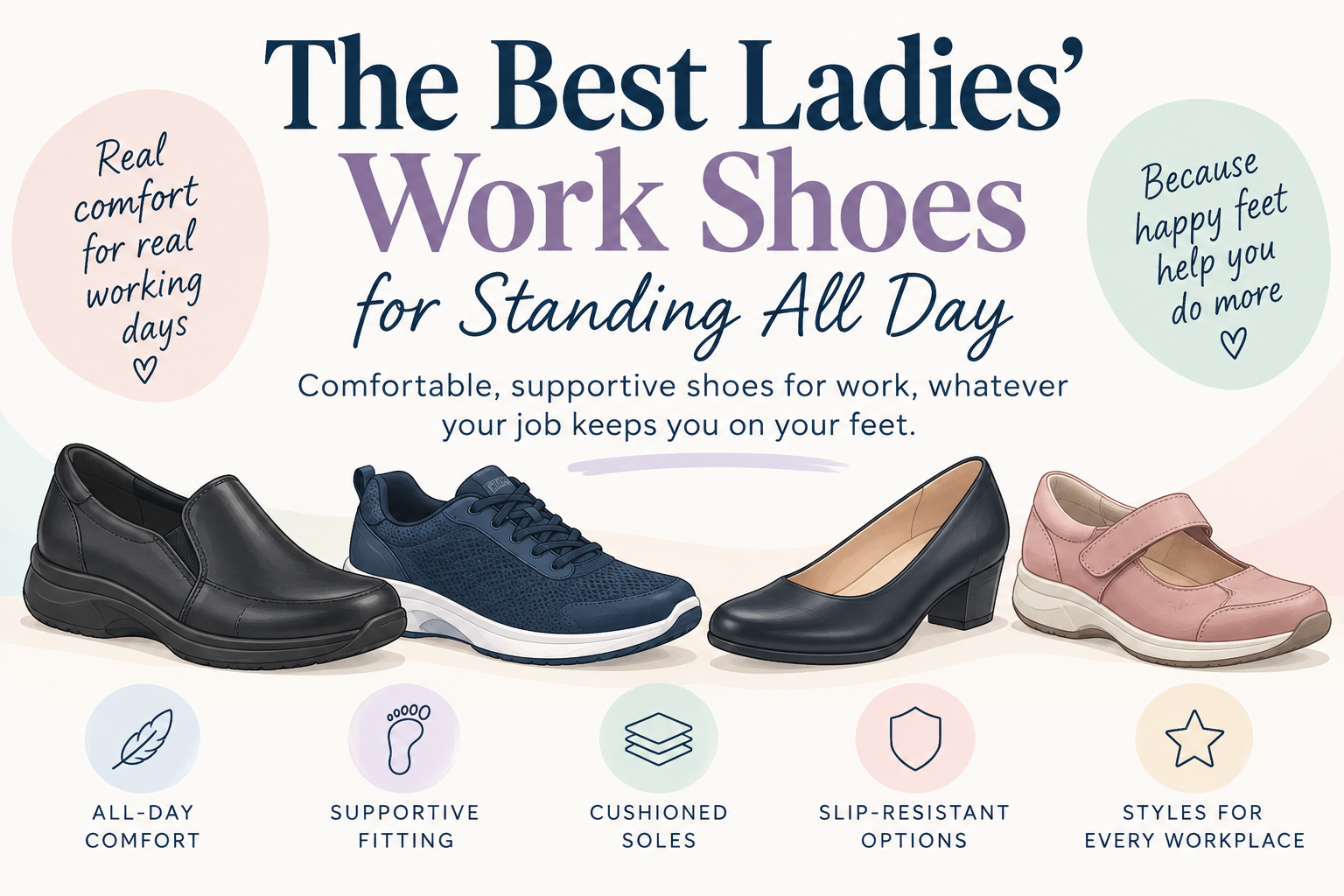
I’ve chosen what I consider to be some of the best ladies’ work shoes for standing all day, particularly for women with wide feet or feet that tend to swell. I’ve included different styles for shops, offices, hospitality and care work, along with some practical advice on finding a comfortable fit.
Affiliate disclosure: This article contains affiliate links. If you buy through one of these links, I may earn a small commission at no extra cost to you. I only recommend products I believe are worth considering for comfort and fit.
Find Work Shoes for Your Job
My Top Picks for Comfortable Women’s Work Shoes
Best Work Shoes for Shop Assistants and Retail Workers
Working in a shop can mean hours on your feet, walking between departments, serving customers and sometimes barely getting a chance to sit down.
I’ve chosen two different styles here: a traditional lace-up shoe with a choice of width fittings and a trainer-style work shoe for those who prefer something sportier.
DB Shoes Lexi – Best for Wide Feet and Roomy Toe Comfort
If you work in retail and struggle to find shoes that don’t squeeze your toes halfway through a shift, the DB Shoes Lexi is worth a look.
These lace-up casual shoes are designed with stretch textile panels that adapt to the shape of your feet, while the square-shaped, seam-free toe area gives sensitive toes a little breathing space. There’s also an air-bubble sole for cushioning as you walk around the shop floor.
Lexi comes in two adjustable-depth fittings: 2V (approximately 2E–4E) and 6V (approximately 6E–8E). Each pair has two removable cushioned insoles, so you can create additional depth or make room for your own orthotics.
What I like: The combination of stretch panels, adjustable laces and removable insoles. If your feet swell during the day, having a little flexibility in the fit can make a real difference. I also like that DB has considered people whose feet need more than just extra width.
Worth knowing: Lexi is a casual comfort shoe, not certified occupational safety footwear. It’s best suited to retail workplaces where ordinary shoes are permitted. The very generous fittings may also be unnecessary if your feet are only slightly wider than average.
View DB Shoes Lexi ↗Skechers Work Sure Track Erath – Best for Roomy, Slip-Resistant Work Shoes
If you spend much of your working day walking around a shop floor, the Skechers Work Sure Track Erath is worth considering. It has a leather upper, traditional lace-up fastening and a slip-resistant outsole designed for workplace use.
The Relaxed Fit design gives your toes and forefoot a little extra room, while the cushioned Memory Foam insole helps soften the impact of standing and walking on hard floors.
What I like: The combination of a roomier toe area, cushioning and a practical leather upper makes Erath a sensible option for retail workers. I also like the adjustable laces, which give you more control over the fit than a slip-on shoe, particularly if your feet become more swollen during the day.
Worth knowing: Relaxed Fit isn’t the same as a designated wide fitting, so Erath may not provide enough room if you need an E, EE or wider shoe. Although it has a slip-resistant outsole, you should still check that it meets your employer’s footwear requirements.
View Skechers Erath ↗Best Shoes for Office Workers and Receptionists
Working in an office or on reception doesn’t mean you have to squeeze your feet into narrow court shoes or spend the afternoon wishing you could kick your heels off!
If you’re regularly standing at a reception desk or walking between offices, you’ll want something that looks smart but still gives your feet room to feel comfortable. I’ve chosen two different styles that could fit the bill.
Gabor G-Fitting Loafers – Best for Smart Office Wear
If you prefer a smart slip-on shoe for work, these black Gabor loafers are worth considering. They have a classic appearance that would look equally at home with smart trousers or a skirt, making them a practical option for office workers and receptionists.
The G fitting offers additional room compared with Gabor’s standard fitting, which may be welcome if ordinary office shoes feel too snug around your forefoot.
What I like: I’ve always been impressed with Gabor’s Comfort range, particularly the attention they give to fit and everyday comfort. I also like that these loafers offer a smarter alternative to trainers without looking overly formal.
Worth knowing: Gabor’s G fitting doesn’t correspond directly to a UK E or EE fitting, so check the manufacturer’s size guidance before ordering. As these are slip-on shoes, you won’t have the same adjustment you’d get from laces or straps. They’re also not confirmed as certified occupational slip-resistant footwear.
View Gabor Loafers ↗Clarks Krystine May – Best for a Classic, Smart Office Shoe
If you prefer a more traditional office shoe, the Clarks Krystine May is a smart alternative to a loafer. It has a black leather upper with a patent toe cap and a low 25mm block heel, so you can look smart without balancing on high heels all day.
It comes in standard (D) and wide (E) fittings, with a cushioned Contour Cushion footbed and a flexible sole.
What I like: It’s a classic style that would look equally at home with smart trousers or a skirt. The low heel and choice of fittings make it worth considering if you need something presentable for work.
Worth knowing: The E fitting may not be roomy enough for very wide or swollen feet. There’s no adjustable fastening either, so getting the fit right from the start is particularly important.
View Clarks Krystine May ↗Best Shoes for Hospitality Workers
Working in a restaurant, café or hotel can mean spending most of your shift on your feet, often on hard floors. Add the occasional spill, and good grip becomes just as important as comfort.
I’ve chosen two different styles for hospitality workers: a roomier, trainer-style shoe and a smarter slip-on option for front-of-house roles.
Skechers Work Nampa Wyola – Best for Comfortable, Slip-Resistant Work Shoes
If you work in a restaurant, café or hotel and spend much of your shift on your feet, Skechers Work Nampa Wyola is worth considering. It has a practical, trainer-style appearance, with a slip-resistant outsole designed for workplace use.
The cushioned Memory Foam insole and roomier Relaxed Fit design are welcome features when you’re walking or standing on hard floors for hours at a time.
What I like: The combination of cushioning, a roomier toe area and a practical work-friendly design makes Wyola an appealing option for hospitality workers. I also like that it offers a more casual alternative to traditional leather work shoes without overlooking the importance of grip.
Worth knowing: Relaxed Fit isn’t the same as a designated wide fitting, so Wyola may not offer enough room if you need an E, EE or wider shoe. Although it’s designed with workplace slip resistance in mind, always check that it meets your employer’s specific footwear requirements.
View Skechers Wyola ↗Gabor Brambling Court Shoes – Best for Smart Front-of-House Work
If you work in hotel reception or another front-of-house role where you need to look smart, the Gabor Brambling court shoes are worth considering.
These leather court shoes have a G fitting, giving a little more room around the forefoot and instep, along with a cushioned footbed and a 4.5cm block heel. They’re a lovely alternative if you want something more elegant than trainers without resorting to narrow, uncomfortable court shoes.
I’m particularly fond of Gabor’s Comfort range. In my experience, they get so many things right – the width, cushioning, support and overall comfort. It’s a range I’ve always been impressed with, although I haven’t personally tested this particular style.
What I like: The combination of a roomier fit, cushioning and a smart appearance. The block heel also gives a broader base than a narrow heel, which is something I’d look for when choosing shoes for a working day.
Worth knowing: These aren’t advertised as certified occupational slip-resistant shoes, so they’re better suited to reception and front-of-house roles where specialist safety footwear isn’t required. And although the G fitting offers additional room, it won’t necessarily be wide enough for everyone.
View Gabor Brambling ↗Best Shoes for Healthcare and Care Workers
If you work in healthcare or care, you’ll know how demanding a shift can be on your feet. Between walking, standing and helping patients or residents, comfortable footwear can make a real difference.
I’ve chosen two different options: a smart leather shoe with a wide fitting and a specialist shoe for women with very wide or swollen feet. Of course, your employer’s requirements for grip, protection and cleaning must come first.
Clarks Un Loop – Best for a Smart, Wide-Fit Leather Shoe
If you prefer a traditional leather shoe for work, the Clarks Un Loop is worth considering. It has a rounded toe, a simple slip-on design and a cushioned footbed, making it a smarter-looking alternative to trainers.
The flexible rubber outsole and wide (E) fitting are useful features if you spend much of your working day on your feet.
What I like: The understated leather style would suit workplaces where smart footwear is preferred. The wide-fitting option and discreet elastic gussets beneath the vamp are useful features, particularly if your feet need a little extra give during the day.
Worth knowing: Although the elastic gussets provide some flexibility, they don’t offer the same adjustment as laces or straps. The E fitting may still be insufficient for very wide or swollen feet. This isn’t specialist occupational footwear with certified slip resistance, so check your employer’s requirements.
View Clarks Un Loop ↗Cosyfeet Evelyn – Best for Very Wide or Swollen Feet
If you struggle to find comfortable work shoes because your feet are particularly wide or prone to swelling, Cosyfeet Evelyn is worth considering. It has a generous 6E fitting, a leather upper and an adjustable strap, making it a practical alternative to traditional work shoes.
The roomy toe area gives your toes more space, while the cushioned insole and flexible sole are welcome features if you spend much of your working day standing or walking.
What I like: The adjustable strap is particularly useful for accommodating changes in foot size throughout the day, especially if your feet tend to swell. I also like that Evelyn has a smart, understated appearance rather than looking like an obvious comfort shoe.
Worth knowing: The 6E fitting is designed for very wide feet and may be too roomy if you only need a slightly wider shoe. The insole isn’t removable, which could be a drawback if you wear your own orthotics. Evelyn isn’t certified occupational footwear, so check your employer’s requirements for slip resistance and protection before buying.
View Cosyfeet Evelyn↗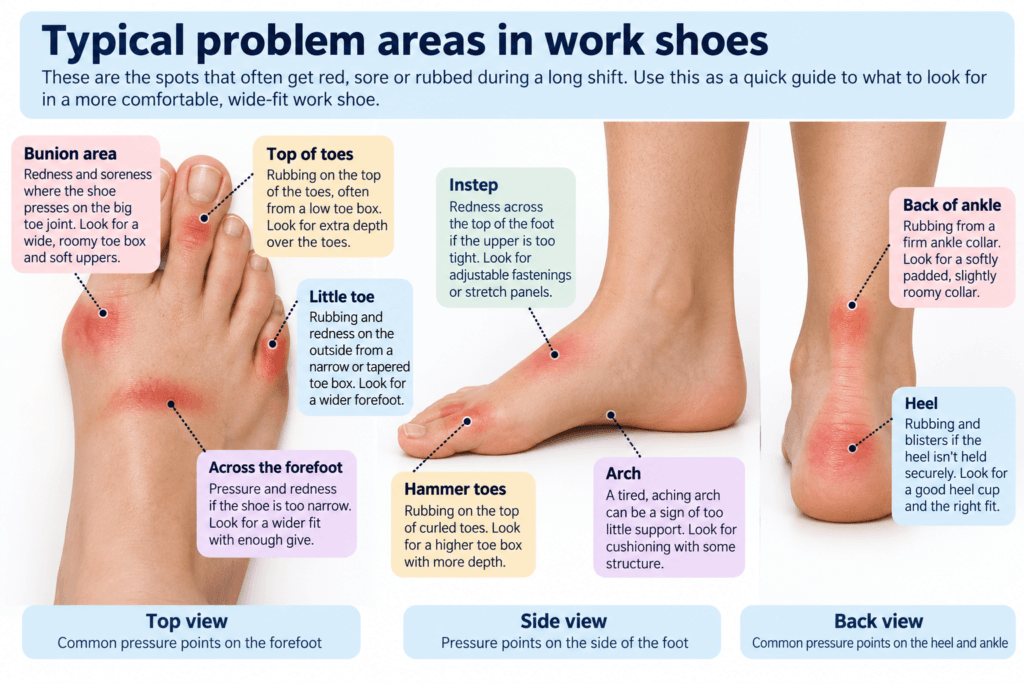
Why your feet feel fine at 9am and miserable by 3pm
A shoe that feels fine when you put it on has only passed the first test. Over a shift, four things tend to go wrong, and each one needs a different fix:
- Swelling. Feet tend to get bigger as the day goes on, especially if you stand still for long stretches. A shoe that fitted at 9am can be tight by mid-afternoon.
- Pressure on bunions and toes. A small amount of rubbing in the morning becomes a sore, hot patch after several hours, because the same spot takes the same pressure thousands of times.
- Aching arches. A hard floor does not give under your feet. If the shoe doesn’t share the load, the arches and the muscles around them do all the work.
- Sore joints. Ankles, knees, hips and the big toe joint feel every step on a hard floor, and a stiff or thin sole passes the full impact up the leg.
Many people find standing still harder on their feet than walking. When you move, your calf muscles help push fluid back up the leg. When you stand at a till or beside a bed, that help drops away and fluid collects in the feet. If you can, take a few steps, rise onto your toes or sit for a minute whenever you get the chance. It won’t fix a badly fitting shoe, but it does take some load off.
One note on swelling. Puffy feet by the end of a long day are common. Swelling that comes on suddenly, affects one leg only or doesn’t go down overnight is worth mentioning to your GP or pharmacist. I’m not a medical professional, so I’d rather you asked someone who is.
Check your workplace rules before you shop. Many employers require closed toes, a non-slip sole, a wipeable upper or a particular colour, and it is much easier to know that before you buy than after the shoes arrive.
Swelling over a long shift: width, fastenings and give
If your feet swell, the shoe has to cope with that. A fixed, snug shoe will be fine for the first hour and painful by the sixth. These are the features I would check first.
Adjustable fastenings. Laces and hook-and-loop straps let you slacken the shoe at lunchtime and tighten it again if your feet settle overnight. Slip-ons rely on the shoe’s own stretch, so look for ones with plenty of it. Elastic at the ankle or across the top of the foot can dig in as swelling builds, so check it carefully.
Real width. Going up half a size adds length you probably don’t need, and your heel starts to slip. A proper wide fit adds room across the ball of the foot and around the instep. Width labels (E, 2E, 3E and so on) vary between brands, and I never trust a universal conversion chart. If the labelling confuses you, my guide to understanding shoe widths explains how it works and why you should treat each brand’s sizing as its own thing.
Depth as well as width. Swollen feet get taller as well as wider. Look for a roomy toe box and enough height over the instep. Some shoes are designed with removable insoles that can be taken out to create extra depth, provided the shoe remains comfortable and supportive.
Soft, stretchy uppers. Knit fabrics, stretch panels and soft leather give a little as your feet expand. Stiff, structured leather doesn’t, and it will hold its shape while your foot pushes against it.
A gentle ankle collar. If your ankles swell too, a firm, narrow opening leaves a ring of pressure. A padded, slightly roomy collar is kinder.
A quick test at the end of a shift is to take your shoes and socks off and look at your feet. Deep red grooves across the top or around the ankle mean the shoe was too tight at some point in the day.
Bunions and sore toes: toe box shape and upper materials
For people with bunions, two common causes of shoe discomfort are a toe box that’s too narrow around the joint and an upper that’s too stiff to accommodate it.
Look at the shape of the toe box first. Foot-shaped, rounded or square toe boxes give the big toe joint and the little toe room. Pointed and tapered shoes squeeze the forefoot, and even a pair advertised as “comfort” can do this if the toe is tapered. Stand on a sheet of paper and draw around your foot, then hold the shoe against the outline. The widest part of the shoe should sit at the widest part of your foot, not in front of it or behind it.
The upper matters just as much:
- Room around sensitive joints. Look for a shoe shape that doesn’t press against bunions or other tender areas. Even a soft upper can become uncomfortable if the shoe is too narrow.
- Seams should not sit across the bunion. Run a finger inside the shoe and feel for stitching, overlays or a hard edge exactly where your joint will be.
- Stretch panels over the bunion area can help, as long as the panel is truly stretchy and not just decorative.
- Linings should be smooth. A wrinkle or ridge you can feel with your finger will be much more noticeable after four hours.
Hammer toes and sore toes need depth above the toes as well as width. If your toes touch the top of the shoe when you stand, it will rub however wide it is. Aim for enough room to wiggle every toe without lifting your heel.
Aching arches and sore joints: cushioning, support and soles for hard floors
People often ask whether they need cushioning or support. On a long shift, you usually want some of each.
Cushioning softens the impact of every step on a hard floor. A midsole with some give makes a noticeable difference on tile, concrete or laminate. Very thin, flat soles, which many smart work shoes have, give you almost no cushioning.
Support can help your foot feel more stable and reduce strain on the arches, particularly when you’re standing or walking for hours. The sole should flex where your toes bend, but it should resist twisting in the middle. Hold the shoe at both ends and try to wring it like a cloth. If it twists easily, it is probably too floppy for a long day.
For flat feet, arch support and a firm heel cup are what I look for first. I’ve written more about this in my guide to the best shoes for flat feet.
A few other sole features are worth knowing about:
- A rocker sole, which is curved from heel to toe, helps your foot roll through each step. Many people with stiff big toe joints or sore ankles find these easier to walk in, though they feel odd for the first few days.
- A non-slip tread matters in kitchens, wards, shops with freshly mopped floors and anywhere else that gets wet. Check the sole itself and not just a claim on the box.
- A low, broad heel is generally more stable than a narrow one. Some people find a small heel more comfortable than a completely flat shoe, so look for a height that feels stable and comfortable throughout the day
- Light weight adds up. A heavy shoe means a lot more lifting over a shift of thousands of steps.
- A removable insole lets you swap in your own cushioning or an orthotic prescribed by a podiatrist.
Fit checks to do before committing to a pair for work
A shoe can pass the first minute and still fail the shift, so test it as close to your working day as you can.
- Try them on in the afternoon or evening. Feet often swell as the day goes on, so trying shoes later in the day gives you a better idea of how they’ll fit towards the end of a shift.
- Wear what you would wear at work. Take your usual socks, tights or hosiery, and any insoles you use.
- Try both feet. Most people have one foot slightly bigger than the other, and you should fit the bigger one.
- Stand up and walk about. Sitting on a shop stool tells you very little. Walk on a hard floor for as long as the shop will allow you.
- Check the toes. You should be able to wiggle them comfortably, with roughly a thumb’s width between your longest toe and the end of the shoe.
- Check the heel. It should stay put when you walk, without rubbing or lifting much.
- Feel for hot spots inside the shoe, particularly over the bunion joint, the little toe and the back of the heel.
If you’re buying online, which is how many wide-fit shoes are bought, wear them indoors on a clean floor for a good stretch before you decide. Do this before you remove the tags or wear them outside, so you can return them if they are wrong. Check the returns policy before you order, including how long you have and who pays for postage.
Many of the problems above begin with a shoe that was the wrong width in the first place. If you’re buying work shoes online, it helps to know your measurements before you order. My guide to measuring foot width at home takes you through it step by step, so you can compare your numbers with each brand’s sizing and choose a pair that suits your feet for the whole shift.
Small adjustments that make a good work shoe better
A decent pair that is almost right can sometimes be rescued with a few small changes.
Insoles. The thin insole that comes in most shoes is often the weakest part. A better insole can add cushioning or support, but it also takes up room. If the shoe is already snug, a thick insole can push your foot up into the top of the shoe and cause the problems you were trying to avoid. If you use a prescribed orthotic, check the shoe has room for it.
Socks and hosiery. Seams over the toes, tight bands at the top and thin fabric that bunches can all cause rubbing. Seam-free, soft, non-restrictive socks make a big difference to comfort in wide shoes, and tights and hosiery matter too if you wear a skirt or your dress code requires it. I’ve covered what to look for in my guide to the best hosiery for wide fitting shoes.
Lacing. A few small changes to how you lace can solve specific problems:
- Skip the eyelets over a bunion or a tender spot on the top of your foot to take the pressure off.
- Lace loosely over the forefoot and more snugly at the ankle if the front of the shoe feels tight but your heel slips.
- Use the extra top eyelet to make a heel lock if your heel lifts.
Rotating pairs. If you can afford two pairs, switching between them gives each one time to dry out and recover its shape. It also changes where the pressure falls from one day to the next.
Breaking in gradually. Wear new shoes for short spells indoors before committing to a full day in them. They may soften slightly with wear, but they shouldn’t need painful breaking in.
Of course, there’s a difference between making a comfortable shoe even better and trying to rescue one that simply doesn’t fit. If a shoe pinches or causes pain from the start, it’s usually better to find another pair
What tends to go wrong with work shoes, and what to look for instead
Some shoe features cause trouble again and again on long shifts. If you see these on the shelf, look twice.
- Narrow or pointed toe boxes. They squeeze the forefoot even if the label says “comfort”. Look for a rounded or square toe with real depth.
- Thin, flat soles. They look neat and give you no cushioning on a hard floor. Look for a midsole that has some give.
- Stiff uppers with seams over the toes. They rub exactly where bunions and hammer toes sit. Look for soft materials and smooth linings.
- Slip-ons that are too rigid. Slip-on shoes can be perfectly comfortable for a long shift, but some offer very little give when your feet swell. Look for flexible uppers, elastic gussets or enough room to accommodate changes in foot size. Laces and adjustable straps are useful alternatives if you need more control over the fit.
- Very soft, squashy foam with no structure. Very soft foam can feel wonderfully comfortable at first, but without enough structure it may leave some people’s feet feeling tired after hours of standing. Look for cushioning that also provides stability.
- Narrow heels and high heels. They are less stable and push weight onto the forefoot. Look for a low, broad heel.
The Bottom Line
Finding comfortable work shoes when you’re standing all day isn’t always easy, especially if you have wide feet, swelling or troublesome joints. What feels comfortable first thing in the morning might be a very different story by the end of your shift!
The best choice will depend on your feet, the type of work you do and any footwear requirements your employer has. Don’t be swayed by appearance alone. A shoe that gives your toes room, supports your feet and stays comfortable throughout the day is worth far more than one that simply looks the part.
Finding the right width and fit won’t make a long shift any shorter, but it might make getting to the end of it a whole lot more comfortable.
About Sue
I’m Sue, the writer behind WiderFittingShoes.com. I know how frustrating it can be to find shoes that look good, fit properly and stay comfortable throughout the day.
I started this website to share what I’ve learned about wide-fitting footwear, explain the sometimes confusing world of shoe widths and help other people find shoes that suit their feet.
And nowadays, comfortable shoes needn’t be frumpy either!