Ever looked at shoe-width letters such as D, E, EE or 4E and wondered what they actually mean? You’re not alone. Shoe-width lettering can be confusing, particularly when different manufacturers use different systems.
In general, shoe-width letters are an indication of how wide a shoe is designed to be. But here’s the frustrating bit: there isn’t one universal UK shoe-width scale. An E fitting from one manufacturer won’t necessarily be the same width as an E fitting from another.
And width isn’t the whole story. Two shoes with the same letter on the box can feel completely different because of their shape, depth and the amount of room around your toes.
I’ll explain how the different lettering systems work, what to look for when comparing UK and German fittings, and why the actual measurements are often more useful than the letters themselves.
I’ll also share some real measurements from manufacturers’ fitting charts, because I’ve learned that guessing your way through shoe widths can become an expensive hobby!
What Is Shoe Width and Why Does It Matter?
Shoe width describes how much room a shoe provides across your foot, particularly around the ball of the foot. But a comfortable fit also depends on the shape of the toe box and how much space there is over the top of your foot.
If your feet are wider than a manufacturer’s standard fitting allows for your shoe size, you may need a wider option. That doesn’t necessarily mean going up a shoe size, which can leave you with too much length.
And you’ll soon know when the width is wrong. Too narrow, and your feet may feel pinched and sore. Too wide, and your feet can slide around, causing rubbing, blisters or that irritating feeling that your shoes are never quite secure.
I’ve learned that a shoe needs to fit properly in more than one direction. The right width is a good starting point, but it’s the overall fit that matters.
What Do UK Shoe Width Letters Mean?
In the UK, shoe-width letters indicate whether a shoe is designed for a standard, wide or extra-wide foot.
Some British women’s footwear brands, including Clarks and Van Dal, use width fittings such as D, E, EE and EEE. The table below shows how these letters are commonly used in women’s shoes.
| Women’s Width letter | Fitting |
|---|---|
| D | Standard |
| E | Wide |
| EE | Extra wide |
| EEE | Extra extra wide |
The higher you go through these fittings, the more room the shoe is intended to provide.
However, not every British manufacturer uses this particular system. Some use different letters or their own descriptions, so it’s always worth checking the brand’s fitting guide before ordering.
And remember, a wider fitting doesn’t necessarily mean a better fit. The shape and depth of the shoe matter too.
Why Do Shoe Width Letters Differ Between Brands?
You’d think an E fitting would be the same whichever shoe shop you walked into, wouldn’t you? Unfortunately, shoe sizing isn’t quite that straightforward.
There’s no single width-letter system used consistently by every manufacturer. Some British brands use E, EE and EEE to describe progressively roomier fittings, while others use different labels or their own measurements. European and American brands can follow different conventions again.
Even when two manufacturers use the same width letter, their shoes won’t necessarily fit alike.
That’s partly because shoes are made around a three-dimensional form called a last. Its shape helps determine the room around your toes, across your forefoot and over your instep.
Two manufacturers can use the same width letter but design their shoes around differently shaped lasts. That’s why one pair may feel comfortable while another feels too tight, even though both are supposedly the same fitting.
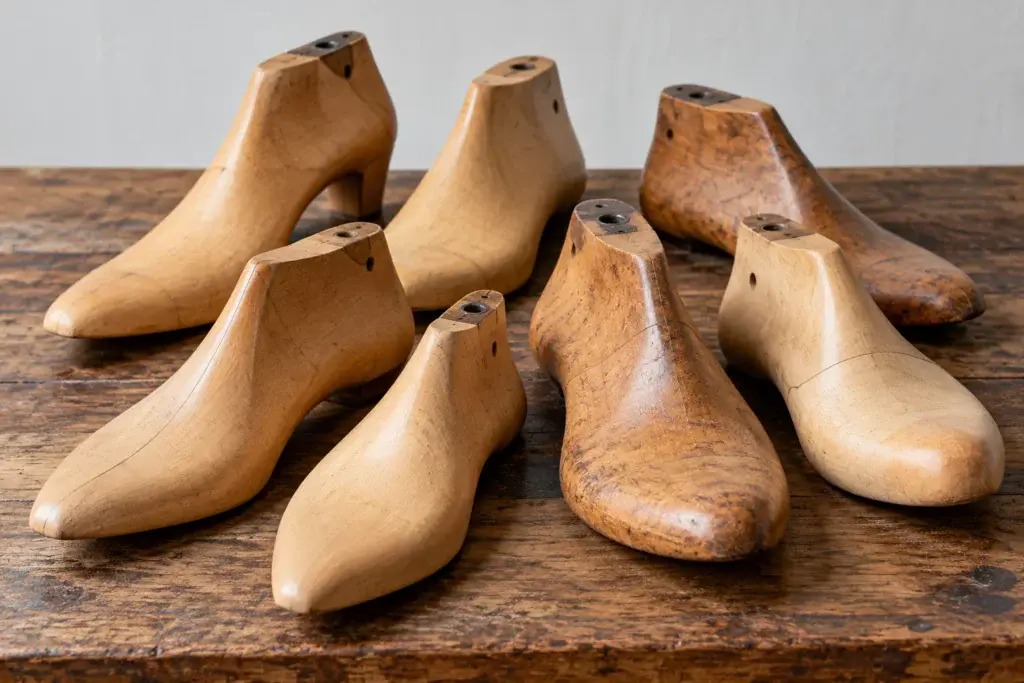
Shoemaker’s lasts come in different shapes and sizes, helping determine the fit and shape of the finished shoe.
Comparing DB Shoes and Waldläufer Width Fittings
Here’s where things get interesting.
DB Shoes uses fittings such as EE, EEE, 4E and 6E, while German manufacturer Waldläufer uses letters including G, H, K and M.
But when we compare their published fitting measurements for a women’s UK size 6, some of the figures are surprisingly close.
These figures refer to the circumference of the foot around its widest part, usually across the ball of the foot. That’s the measurement you’d get by wrapping a flexible tape measure around your foot, rather than measuring straight across it.
DB Shoes and Waldläufer Width Comparison — Women’s UK Size 6
| DB Shoes fitting | Foot circumference (cm) | Waldläufer fitting | Foot circumference (cm) |
|---|---|---|---|
| E | 23.0 | — | — |
| EE | 23.7 | G | 23.5 |
| EEE | 24.2 | H | 24.0 |
| 4E | 24.9 | K | 25.0 |
| 6E | 26.2 | M | 26.0 |
| 8E | 27.5 | — | — |
Figures are from the manufacturers’ fitting guides for a women’s UK size 6. Waldläufer fittings are shown alongside DB Shoes fittings with similar recommended foot circumferences, not as official width equivalents.
You can see the original information in the DB Shoes measuring chart and Waldläufer shoe-width guide.
If you’re considering DB Shoes, their Shoe Fit Finder is worth trying. It uses both your foot length and circumference to suggest a suitable size and fitting, including their variable-fit options.
Look at the DB 4E and Waldläufer K fittings. Their listed measurements differ by just 1 mm.
Does that make them interchangeable? Not necessarily. Similar measurements don’t guarantee that two shoes will fit the same way.
What this comparison does show is why it’s worth looking beyond the letters. Two fittings that sound completely different may actually be intended for feet with very similar measurements.
What I’ve Found From Wearing Both
In my own experience, I’ve found that Clarks E-width shoes and Waldläufer H-width shoes can fit me equally well. I wear both fittings comfortably, depending on the style.
That doesn’t mean they’re officially equivalent, or that they’ll fit everyone the same way. It’s simply what I’ve discovered from wearing them.
How Do Dual-Fitting Shoes and Removable Insoles Help With Width?
If you’ve ever been caught between two fittings, or your feet tend to swell during the day, dual-fitting shoes are worth knowing about.
Dual-fitting shoes are designed to offer two fitting options, usually by including a removable insole. Leave it in for a snugger fit, or remove it to create a little extra space inside the shoe.
I find removable insoles particularly useful because my right foot is larger than my left. In some of my shoes, I remove the right insole to give that foot a little more room, while leaving the left one in place. It’s a simple adjustment, but it can make a real difference to my comfort.
Removable insoles can also be useful if you wear orthotics, provided the shoes have enough room and depth to accommodate them properly.
One thing worth remembering is that removing an insole creates extra space inside the shoe, particularly in depth. It doesn’t actually make the sole or the shoe’s underlying shape any wider.
How Do You Know If Your Shoes Are Too Narrow or Too Wide?
A shoe can be the correct length and still be too narrow for your feet. I’ve learned that from years of dealing with arthritis and feet that have changed after surgery.
And going up a shoe size isn’t necessarily the answer. You might gain a little extra room across your foot, but you’ll also end up with a longer shoe that may not fit securely.
Signs your shoes may be too narrow include:
- Your toes feel squeezed or rub against each other.
- The sides or tops of your toes become sore or red.
- Your feet seem to spill over the edges of the soles.
- You notice rubbing or pressure marks after removing your shoes.
But shoes can be too wide as well.
If your feet slide from side to side, your heels keep slipping, or you find yourself gripping with your toes to keep your shoes on, there may be too much room.
The aim isn’t simply to find the widest shoe available. It’s to find one that gives your toes enough space while keeping the rest of your foot comfortably secure.
A shoe made on a wider last may provide that extra forefoot room without adding unnecessary length.
Of course, these signs don’t always mean width is the problem. Persistent pain, numbness or unexplained swelling should be discussed with an appropriate healthcare professional rather than assuming a different pair of shoes will solve it.
How Do You Find the Right Shoe Width and Fit?
Once you understand what shoe-width letters mean, the next step is finding a pair that actually fits your feet.
Here are a few things I’ve learned over the years:
- Measure both feet. One foot may be longer or wider than the other. My right foot is larger than my left, so I know this one from experience!
- Try shoes later in the day. Feet can swell as the day goes on, particularly if you’ve been standing or walking.
- Wear your usual socks. Thicker socks can make a surprising difference to how snug a shoe feels.
- Check the manufacturer’s fitting guide. Compare your measurements with the brand’s recommendations rather than relying on the width letter alone.
- Pay attention to the upper material. Leather may soften and give slightly with wear, while some synthetic materials are less forgiving. But don’t buy painfully tight shoes hoping they’ll eventually stretch.
- Check the room over your instep. A shoe can be wide enough across your forefoot but still feel tight over the top. If that’s a familiar problem, my guide to choosing shoes for a high instep may help.
- Walk around before deciding. Your toes should have enough room to move, without your heels slipping excessively or your feet sliding around inside the shoes.
Buying Shoes Online? There Are Advantages!
I’ve bought plenty of shoes online over the years, and there are some definite advantages to trying them on at home.
For one thing, there’s no salesperson hovering nearby while you decide whether they’re comfortable. You can take your time, try them with your usual socks and walk around on your own clean floors to see how they feel.
You can even try them at different times of the day, which is particularly useful if your feet tend to swell.
But always check the retailer’s returns policy before ordering. Make sure you have enough time to try the shoes properly, that returns are straightforward, and whether you’ll have to pay the return postage.
And keep the shoes and packaging in good condition while you’re deciding. Trying them indoors on clean surfaces is very different from taking them for a walk down the road!
Personally, I’d much rather send an unsuitable pair back than keep another expensive mistake at the bottom of my wardrobe.
And if you’re still struggling to find comfortable footwear, I’ve brought together the lessons I’ve learned from arthritis, four joint replacements and years of footwear mistakes in my Wide Fit Shoe Survival Guide.
Frequently Asked Questions About Shoe Widths
What does B mean in shoe width?
In many American footwear sizing systems, B is considered a standard width for women’s shoes but a narrow fitting for men’s shoes.
However, that doesn’t mean every manufacturer uses B in exactly the same way, so check the brand’s fitting information.
What does 2E mean in shoe width?
2E, sometimes written EE, is commonly used for wider-fitting shoes, particularly in American footwear.
In many US brands, 2E is considered wide for men and extra-wide for women. But it isn’t a fixed measurement that applies to every manufacturer.
Can I wear wide-fit shoes if only one foot is wide?
Yes. If one foot is wider than the other, choose shoes that comfortably accommodate your larger foot. Removable insoles or adjustable fastenings may help you fine-tune the fit for each foot, although removing an insole adds internal space rather than making the shoe itself wider.
Will going up a shoe size give me more width?
It may give you some extra room, but it also increases the length of the shoe. That can leave your heel slipping or your foot moving around inside.
If the length is already right, trying a wider fitting is often a better starting point.
The Bottom Line
Shoe-width letters are a useful starting point, but they don’t tell you everything about how a shoe will fit.
After years of trying to find comfortable footwear for two very different feet, I’ve learned that the shape and depth of a shoe can be just as important as its width fitting.
Check the manufacturer’s measurements, pay attention to how the shoes feel, and don’t assume that going wider automatically means going more comfortable.
Whether you need an E, EE or 4E fitting, the aim is the same: shoes that fit your feet properly, rather than expecting your feet to fit the shoes.
For more advice, have a look at my Complete Wide Fit Shoes Guide.
About Sue Holland
Sue writes WiderFittingShoes.com from first-hand experience of finding footwear for wide and difficult-to-fit feet. After two hip replacements, two ankle replacements and years of dealing with arthritis, swelling and feet that don’t always behave the same from one day to the next, she shares the practical things she’s learned about shoe fit, width and comfort.