
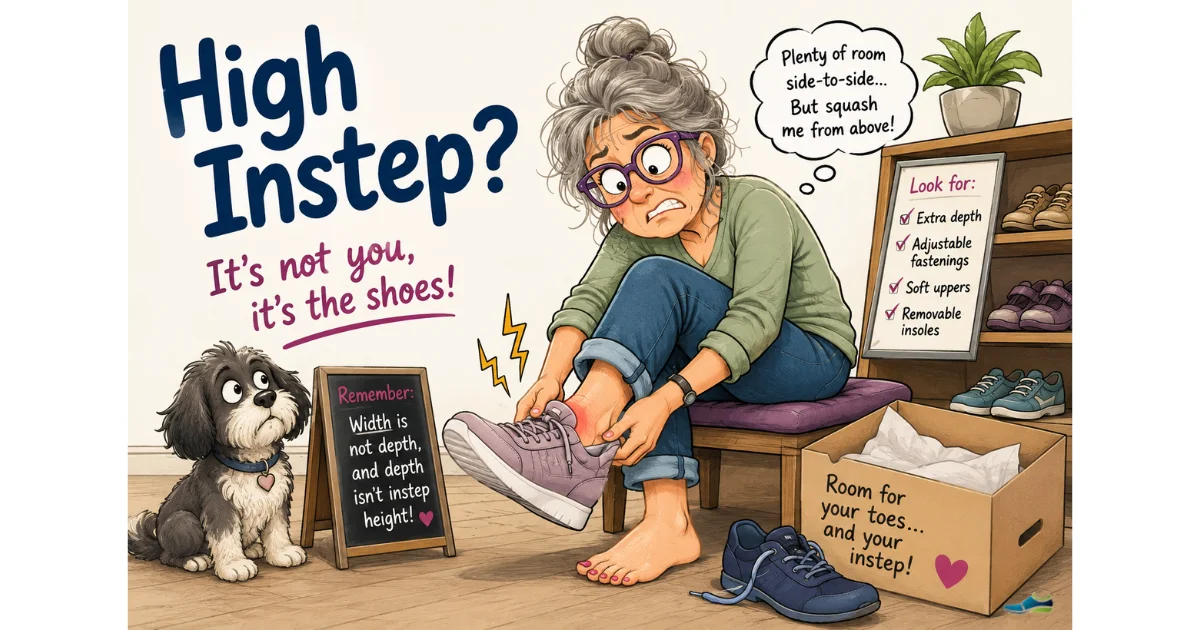
How annoying is it when you’re trying to buy shoes and the length is right, the width seems fine, yet the shoe still feels painfully tight across the top of your foot. If that sounds familiar, the problem may not be your shoe width at all. You may have a high instep and simply need shoes with more depth and volume.
The best shoes for a high instep have enough vertical room over the top of the foot, together with adjustable fastenings such as laces, straps or Velcro. Soft, flexible uppers and something not many people consider, removable insoles, these can give extra height and ease that pressure.
Affiliate disclosure: This article contains affiliate links. If you buy something through one of these links, I may earn a small commission at no extra cost to you.
Forcing a high instep profile into standard fashion footwear is a surefire way to trigger severe under-lace compression and deep skin irritation. When a shoe lacks sufficient vertical clearance, the stiff tongue and throat materials press directly against the prominent bone ridge on the top of the foot, leaving angry red indentations across your skin after only a few minutes of walking.
My decades of navigating complex lower-limb reconstructions and managing severe arthritic changes have taught me that the dorsal aspect of the foot handles vertical mechanical pressure incredibly poorly, as it is packed with highly sensitive surface nerves. Managing this painful constriction safely requires stepping away from traditional footwear shapes.
While adopting alternative parallel lacing patterns or choosing stretchable fabric uppers offers excellent temporary relief, the real secret to lasting mobility lies in selecting shoes built on dedicated extra-depth lasts. Choosing high-volume chassis designs ensures your foot has the true vertical room it needs to rest naturally without being squashed by stiff leather edges, completely eliminating focal friction points and protecting your skin boundaries from painful rubbing.
What Is a High Instep?
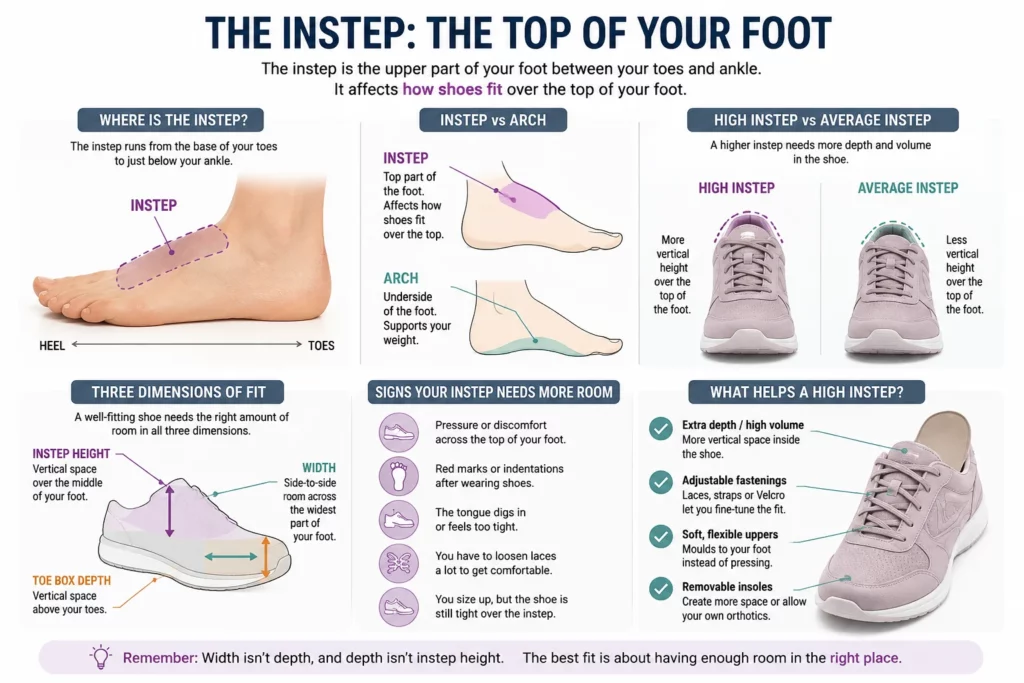
Your instep is the upper part of your foot between your toes and ankle. If this area sits higher than average, you may find that otherwise correctly sized shoes press uncomfortably across the top of your foot.
A high instep is sometimes confused with a high arch, and often the two are present, but they’re not quite the same thing. Your arch is underneath your foot, whereas your instep is on top. It’s possible to have a high instep without having particularly wide feet, and you can even have a high instep alongside relatively flat feet.
Knowing the difference really matters when buying shoes.
A wider fitting mainly provides more side-to-side room. What a high instep needs is more vertical volume through the middle of the shoe.
Signs Your Shoes May Be Too Shallow Over the Instep
One of the biggest clues is a shoe that seems to fit everywhere except across the top.
You might notice that your laces have to be loosened considerably, the tongue presses into your foot, or you develop red marks after wearing your shoes. Slip-on shoes can be particularly awkward because there’s little or no way to adjust the amount of room over the instep.
You may even find yourself falling into the trap of buying a larger shoe size just to get enough room.
That’s rarely an ideal solution. You can end up with unnecessary length in front of your toes or a loose heel while the shoe still doesn’t fit properly where you actually need the space.
Width, Toe Box Depth and Instep Height Aren’t the Same Thing
This is something that’s easily overlooked when buying wider fitting shoes.
Imagine a shoe in three dimensions rather than just looking at its size label.
Width is the room from side to side.
Toe box depth is the vertical space above your toes.
Instep volume is the room farther back, over the top of your foot.
You can need more of one without needing more of the others.
Someone with broad feet may need additional width but have a perfectly ordinary instep. Someone else may have average-width feet but struggle to get them into a shallow shoe because of a high instep.
And some of us need extra room in several directions at once!
That’s why the word “wide” on a shoe box doesn’t guarantee a comfortable fit.
What to Look for in Shoes for a High Instep
Extra Depth
Depth is one of the first things I’d look for.
You need enough room between the footbed and upper so the shoe isn’t pressing down on the top of your foot. NHS footwear guidance similarly recommends adequate shoe depth, particularly where additional room is needed inside the shoe.
Terms such as extra depth, deep fitting or high volume can therefore be useful when you’re shopping. Don’t rely entirely on the description, though. Shoe shapes vary enormously between manufacturers and even between models from the same brand.
Adjustable Fastenings
Laces are particularly useful because you can alter the fit at different points along the shoe.
If the pressure is mainly across your instep, you can leave that section slightly looser while still securing the shoe properly elsewhere.
Velcro straps can work well for the same reason, particularly when the straps are long enough to accommodate a higher-volume foot.
A combination of laces and a side zip can also be very convenient. Once you’ve adjusted the laces to suit your foot, the zip can make getting the shoes on and off much easier.
Soft, Supple Uppers
A rigid upper has very little sympathy for a high instep.
Soft leather, flexible mesh and other forgiving materials can adapt more readily to the shape of your foot rather than creating a hard pressure point across the top.
That doesn’t mean the whole shoe should be floppy. You can still have a supportive sole and heel structure while having a softer upper where your foot needs a little give.
Slip-on shoes with elastic across the top of the feet can also help, just be careful that the elastic has some give.
Removable Insoles
I think removable insoles are one of the most useful — and underrated — features in footwear.
Taking out a thick removable insole can create valuable extra internal volume. It also allows you to substitute your own orthotic where appropriate rather than trying to squeeze an orthotic on top of an already bulky footbed.
Footwear guidance from NHS orthotics services specifically mentions removable insoles as a way of creating additional room inside a shoe.
What I’d Actually Look For
If you’ve got a shoe that’s right everywhere except across the instep, a proper vamp or instep stretcher — not a standard width stretcher — is the tool worth having. It lifts the upper without changing the width, which is exactly the targeted fix a high instep actually needs.
I have a dedicated post on how to stretch the instep of trainers that may help if you have already bought some that are lacking in height.
Sizing Guidance: Because upper volume measurements differ significantly between fashion lasts and clinical shoe designers, always check the manufacturer’s physical structural dimension charts and internal depth scales on their packaging to confirm the shape safely handles your unique volume requirements.
Check vamp & instep stretchers on Amazon
A Sensible Toe Shape
Having a high instep doesn’t mean you should forget about the other parts of the fit.
Your toes still need enough length, width and height to move comfortably. Rounder or squarer toe shapes generally give the toes more usable room than sharply pointed designs.
A shoe that accommodates your instep but squashes your toes has merely moved the problem somewhere else.
Sue’s Experience: Internal Shoe Space Matters
I don’t have a particularly high instep, but I’ve learnt a lot about the importance of internal shoe volume through wearing orthotics, dealing with swelling and needing plenty of height over my toes.
An orthotic takes up room inside a shoe. Swelling can change how much room I need from one day to another, and I also have what I jokingly call my “chubby toes” — they’re deep in height, so a shoe can technically be wide enough and still press down uncomfortably from above.
That’s one reason I pay so much attention to removable insoles, adjustable fastenings and the actual depth of a shoe rather than simply looking at the width fitting on the box.
I’ve learnt that where the extra room is located matters just as much as how much room there is.
Can You Stretch Shoes for a High Instep?
Sometimes — and this is where choosing the correct type of shoe stretcher becomes important.
A normal width stretcher isn’t necessarily going to solve a shoe that’s tight across the top of your foot.
For that, there’s a specialist tool called a vamp or instep stretcher.
The vamp is the upper section of the shoe covering the top of the foot. A vamp/instep stretcher is designed to create additional space in this area. Specialist stretcher manufacturers distinguish these from toe-box raisers, which work farther forward and create extra height over the toes. Don’t get these mixed up.
If the shoe is pressing on the top of your toes, you need to address toe-box height.
If it’s pressing farther back across the top of your foot, that’s where a vamp or instep stretcher may be more appropriate.
And if the shoe is simply squeezing the sides of your foot, you’re dealing primarily with width.
Three similar and common complaints — three different fitting problems.
Which Shoes Can Be Stretched Over the Instep?
Material matters.
Natural leather and suede generally have more potential to give than rigid synthetic materials. Stretching spray can also help soften suitable material while it’s being stretched.
However, stretching should be used to make a small adjustment to an otherwise suitable shoe. It isn’t a good way of turning a fundamentally wrong shoe into the right one.
If a shoe is dramatically too shallow for your foot from the moment you put it on, it’s better to find a deeper shoe than try to force it into submission.
You can read my shoe stretcher spray guide for more on how stretching sprays work and which materials are suitable.
Don’t Automatically Size Up
This is probably one of the easiest traps to fall into.
If a size 6 presses on your instep, a size 7 may feel roomier — but you’ve also added length that you didn’t need. That can leave the heel moving around and the foot sliding forwards inside the shoe.
Instead, try to find the correct length with greater depth or adjustability.
When trying shoes on, wear the socks, hosiery or orthotics you normally use. If your feet tend to swell during the day, trying shoes later in the day can also give you a more realistic idea of the space you’ll need.
NHS footwear guidance recommends both approaches.
High Instep and Wide Feet
Of course, you can have both.
If your foot needs extra width and additional room over the instep, simply choosing a wider fitting may or may not solve the problem.
Look for shoes described as wide and extra depth, and pay particular attention to the fastening system and upper construction.
This is also where shopping by measurements rather than assuming your usual shoe size can save a lot of frustration.
Nowadays, footwear manufacturers are beginning to use the same terms because they understand the diverse needs which at one time weren’t acknowledged.
The Bottom Line
Choosing shoes for a high instep is really about finding room in the right place.
Don’t assume that tightness across the top of your foot means you automatically need a bigger or wider shoe. Look for adequate depth, adjustable fastenings, softer uppers and removable insoles that allow you to fine-tune the internal space.
And if a favourite pair fits beautifully everywhere except over the instep, a vamp or instep stretcher may be worth considering. Just remember that it isn’t the same tool as a toe-box raiser or ordinary width stretcher.
Once you start thinking about shoes in three dimensions — length, width and depth — a lot of those mysterious “They’re my size, so why on earth don’t they fit?” moments begin to make sense.
FAQs About High Instep Shoes
What does having a high instep mean?
A high instep means the upper part of your foot has greater-than-average vertical height or volume. Shoes may therefore feel tight across the top even when their length and width are correct.
Is a high instep the same as a high arch?
No. The arch is underneath the foot, while the instep is on top. You can have a high instep without necessarily having a high arch.
Do I need wide shoes if I have a high instep?
Not necessarily. Width provides additional side-to-side room, while a high instep primarily requires more vertical volume. Some people need both.
What type of shoes are best for a high instep?
Look for shoes with good internal depth, adjustable laces or straps, soft uppers and removable insoles. Extra-depth footwear can also be useful.
Are lace-up shoes good for high insteps?
They can be particularly useful because the tension can be adjusted over different areas of the foot rather than relying on a fixed upper.
Can I remove an insole to make more room?
If the manufacturer has designed the insole to be removable, taking it out can provide additional internal depth. It can also create room for an appropriate orthotic.
Can a shoe stretcher help a high instep?
A vamp or instep stretcher can sometimes create additional room across the top of a suitable shoe. It’s different from a width stretcher or toe-box raiser.
Should I buy a larger shoe size for a high instep?
Usually it’s better to find the correct length with sufficient depth rather than buying unnecessary extra length purely to gain volume.
Can high-instep feet also be wide?
Yes. Foot width and instep height are separate dimensions, so it’s perfectly possible to need both a wide fitting and extra depth.
What is the difference between a vamp stretcher and a toe-box raiser?
A vamp or instep stretcher targets the upper over the middle/top of the foot. A toe-box raiser works farther forward to increase vertical room over the toes.
Medical Disclaimer: The technical footwear parameters, structural volume metrics, and conservative modification suggestions compiled across this guide are provided strictly for general informational and educational purposes. They do not substitute for personalised professional medical advice, clinical diagnosis, or distinct orthopaedic rehabilitation programs. Persistent top-of-foot pain, sudden severe structural swelling, or signs of progressive nerve compression require direct assessment and consultation with a qualified GP, registered podiatrist, or orthopaedic specialist.