
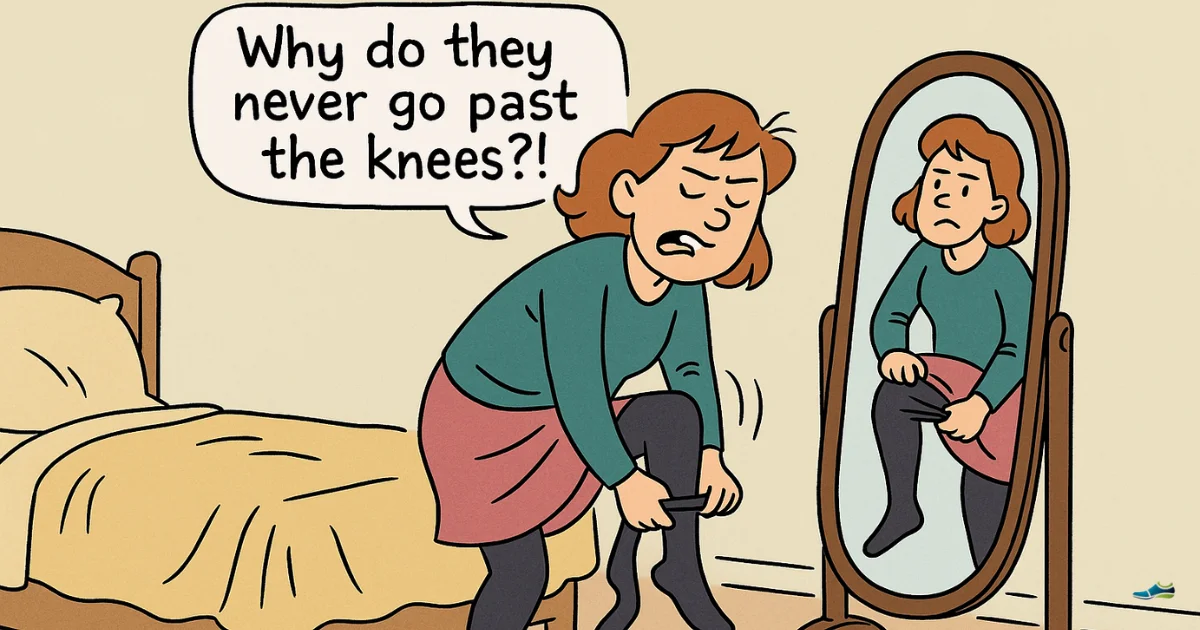
You pull, you wiggle, you pray — and your tights still roll at the thigh before coffee break.
If that sounds familiar, you’re not the problem. The hosiery industry is.
For decades, brands have treated “one-size-fits-all” as gospel, squeezing every shape into a tube of nylon that barely fits anyone. But comfort, stretch, and proper fit shouldn’t be a luxury — they should be the starting point. Especially for those of us with wider feet, thicker calves, or fuller thighs who are tired of feeling like the afterthought in every sizing chart.
Don’t guess your size — measure it. Our at-home foot width guide makes it easy to understand why some hosiery digs in while others glide on.
If swelling or heat build-up are part of your daily battle, don’t stop at hosiery — explore our guide to socks for swollen feet. They’re designed to manage circulation, not cut it off.
It’s time to talk about how to choose hosiery that actually fits your body — not the mannequin’s.
If you need further information regarding wide fit hosiery, read my Hosiery For Wide Feet Guide
📌 At a Glance — Hosiery That Finally Fits
- ✔️ Wider knitting forms — real shape for hips, calves, and thighs (not just added length).
- ✔️ Soft-hold waistbands — stretch without the “sausage squeeze.”
- ✔️ Reinforced toes & heels — no more overstretch or tearing on wide feet.
- ✔️ Breathable yarns — bamboo, microfibre, and merino keep things cool and soft.
- ✔️ True multi-sizing — avoid “one-size-fits-none” marketing claims.
Why Most Hosiery Gets Wide Fit Wrong
Standard tights and stockings are made on narrow knitting forms, then simply stretched to claim “plus size” status. The result? You get fabric that digs, rolls, or tears at stress points.
Add narrow feet or small heels into the mix, and suddenly you’ve got bunching at the toes and pulling at the thighs – a combination for discomfort.
Proper wide-fit hosiery isn’t about vanity sizing. It’s about correct engineering.
When the weave, gusset, and fibre blend are designed for real shape and movement, everything changes — no pinching, no slipping, no seams doing battle with your knees.
What True Wide-Fit Hosiery Should Offer
If you’re constantly adjusting, folding, or cutting the waistband just to breathe — it’s not your body that needs fixing. It’s your hosiery.
Here’s what good wide-fit design actually looks like:
- Wider knitting forms: These create extra circumference through the hips and thighs without just adding length.
- Proper gusset zones: A diamond or double gusset gives comfort where it matters most.
- Reinforced toes and heels: Prevents over-stretching and premature wear, especially on wider feet.
- Supportive waistband: Soft-hold rather than sausage-casing tight.
- Graduated stretch: Tighter where it supports, easier where you move.
If you can’t remember the last time you got through a day without yanking your tights up, you deserve better hosiery.
The Material Myths That Ruin Comfort
“Denier” doesn’t equal durability, and “elastic” doesn’t mean comfortable.
Many high-street brands cut costs with heavy synthetics that trap heat and hold sweat — a recipe for irritation if you’ve got swelling, arthritis, or wider feet that need room to breathe.
What works better:
- Bamboo and microfibre blends – naturally breathable, wick away moisture.
- Nylon with Lycra® – adds controlled stretch without losing shape.
- Merino wool hosiery – soft, temperature-regulating, and brilliant for winter.
- Modal or viscose – smoother on sensitive skin and less likely to cling.
🚫 Skip “one-size” anything. It’s just marketing. Always look for multi-size or graded-fit ranges with clear calf and thigh measurements.
Tights vs. Stockings vs. Hold-Ups
Here’s the truth no one says out loud: hold-ups and stockings often fit better for wide calves and legs than tights do — because there’s less fabric to fight with.
- Tights – Great for everyday wear, but choose ones with high elastane content and a deep waistband that won’t roll.
- Stockings – Ideal for layering under dresses or skirts; choose wide-top bands with silicone grip that’s non-irritating.
- Hold-ups – If yours roll, it’s not you — it’s the band. Look for dual silicone bands or lace-lined options with stretch lace tops.
Sometimes the most comfortable solution isn’t a different size. It’s a different style.
How to Spot Genuine Wide-Fit Hosiery Online
Shopping online for hosiery can feel like decoding hieroglyphics. To make it easier:
- Check product photos carefully. If the model only shows size 8 legs — red flag.
- Read the fabric content. You want 10–20% elastane minimum for flexibility.
- Search for “wide calf,” “plus fit,” or “comfort top” rather than “one-size.”
- Look for reinforced toes or foot-shaped knit. That’s your friend if you have wide feet.
- Avoid shiny finishes. Matte or semi-opaque styles stretch and move more naturally.
And remember: good hosiery shouldn’t leave red rings, pull seams, or feel like a workout to put on.
Styling Confidence: Comfort First, Always
Hosiery that fits isn’t just about avoiding pain — it’s about confidence.
When your tights don’t slip or your hold-ups stay up, your whole posture changes. You stop fidgeting, start moving more freely, and maybe even rediscover the outfits you’d written off as “too clingy.”
It’s not vanity — it’s intervention. You’re choosing pieces that work with your body, not against it.
FAQs
Q: Why do tights always roll down on wider waists or thighs?
A: Because most “plus” tights are just longer, not wider. Proper wide-fit pairs use different knitting forms that add stretch where you need it — through hips and thighs — so they stay put.
Q: Can I wear hold-ups if I have wide calves?
A: Yes, absolutely. Just choose wide-top bands with silicone grip designed for comfort, not pressure. Avoid narrow lace trims — they’re the first to dig in.
Q: Are bamboo or microfibre tights cooler to wear?
A: Yes. Both materials breathe better than standard nylon and reduce that sticky feeling after hours of wear. They’re also softer and less likely to snag.
About Sue Holland
Sue Holland writes from lived experience — she’s had two hip replacements, two ankle replacements, flat feet, arthritis and chronic swelling. Her goal is to help readers find real-world comfort, not just theory.
Disclaimer: Sue is not a clinician. Her posts reflect personal experience and research. Always follow your clinician’s advice for diagnosis or treatment.