
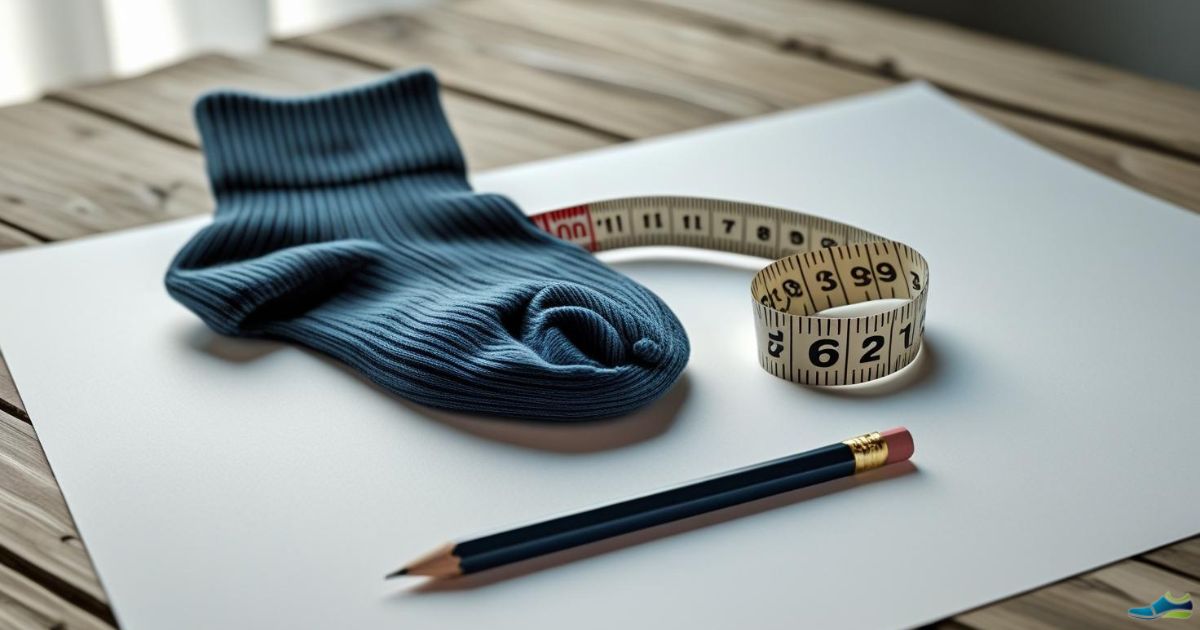
Most people know their shoe size in length, but few know the circumference around the widest part of their foot. That’s why shoes can feel comfortable initially but begin to pinch after a few hours. This guide shows you how to measure your forefoot circumference at home and use the calculator below to find your closest approximate width fitting. All you need is a soft measuring tape and a few minutes.
Once you find your measurements using our guide below, you can instantly see which premium UK comfort brands (like Clarks and Cosyfeet) match your exact width code.
If you already know your measurements and width size, my Complete Wide Fit Shoes Guide explains how to use those measurements to choose shoes that actually fit comfortably.
Affiliate disclosure: This article contains affiliate links. If you buy something through one of these links, I may earn a small commission at no extra cost to you.
How to Measure Your Foot Width for the Calculator
This calculator uses the circumference around the widest part of your forefoot, rather than the straight-line width across a traced outline. You’ll need a soft measuring tape marked in centimetres. If you don’t have one, use a piece of non-stretchy string and measure it against a ruler afterwards.
Step 1: Measure Later in the Day
Feet can become slightly larger as the day goes on, especially if you experience swelling. Measure in the late afternoon or evening, when your feet are more likely to be at their largest.
Step 2: Stand with Your Weight Evenly Distributed
Measure your bare feet while standing on a firm, level floor. Keep your weight distributed as evenly as possible between both feet. If you can, ask someone to take the measurement for you so that you can remain standing naturally.
Step 3: Measure Around the Forefoot Joint
Wrap the tape around the widest part of your forefoot, usually across the ball of the foot and around the joints beneath the big toe and little toe. This is sometimes called the ball girth or forefoot circumference.
Keep the tape comfortably against your foot without pulling it tight or leaving it loose. Record the measurement in centimetres to the nearest millimetre—for example, 24.3 cm.
Step 4: Measure Both Feet
Repeat the process on your other foot because one foot is often wider than the other. Enter the larger circumference into the calculator, as this is the foot your shoes will need to accommodate.
Sue’s tip: Take each measurement twice. If the figures differ, measure once more rather than averaging them—small changes in the position or tension of the tape can affect the result.
Shopping from the US? Convert Your Size First
This calculator uses UK sizing. If you normally wear a US women’s size, subtract 2 to get your approximate UK size (a US 8 is roughly a UK 6). For US men’s sizes, subtract 0.5 to 1 (a US 9 is roughly a UK 8 to 8.5). Use that converted UK size in the calculator below, alongside your forefoot circumference measurement.
Step 5: Try the Foot Width Calculator
Enter your usual UK shoe size and the larger of your two forefoot-circumference measurements. The calculator compares your measurement with Waldläufer’s German fitting system and gives you the closest width code, together with an approximate UK equivalent. We use Waldläufer as the reference point because they’re one of the few brands that publish precise, consistent forefoot measurements across their full size range — most brands don’t document this level of detail.
Foot Width Calculator
Use your larger forefoot measurement and enter it in centimetres.
This calculator provides a fitting guide, not a guarantee of fit. Width letters and shoe shapes vary between manufacturers and individual styles.
Measurement comparison based on the Waldläufer shoe fitting guide .
Next Step: Matching Your Width to the Right Brand
Now that you have used the calculator to find your approximate width code, you need to match it to a manufacturer that natively accommodates your foot shape. Width letters vary significantly between brands, so here are the best places to start:
For Standard Wide & Extra Wide Fits (UK E to EE fits)
For everyday standard width needs, Clarks remains a highly accessible high-street benchmark. When exploring their designated Women’s Wide (E) or Extra Wide (EE) selections, focus on unstructured, flexible leathers that naturally flex to accommodate your forefoot splay.
Sizing Tip: Always check the physical sizing charts and width rating labels on the merchant’s official site to ensure your raw centimeter measurements map comfortably to their specific style lasts.
Best for: Daily smart-casual wear, standard wide fits, and high-street accessibility.
For Extreme Width, High Insteps, or Severe Swelling (UK EEE to 6E+ fits)
Visually, when lower limbs display a significant circumference expansion, localized tightness across the instep, or asymmetric fluid buildup, standard high-street footwear will inevitably pinch the joints. This physical presentation is highly consistent with severe swelling (edema) or changing foot structures. For these deep-volume needs, Cosyfeet provides premium UK specialized roomy designs, utilizing stretchable front panels and extension straps engineered for therapeutic comfort. Best for: Extreme volume profiles, altered joints, fluid retention, or thick orthotic insoles.
Best for: Extreme width, rigid joints, fluid retention, or thick orthotic insoles.
However, if you’ve measured your feet and your shoes still feel tight across the top of your toes, the problem may not be width at all. Some people actually need extra height inside the front of the shoe rather than extra width. You can learn more in my guide to choosing a high volume toe box.
Once you’ve measured your width, the next step is understanding what those numbers mean. Check out our Wide Shoe Widths Explained guide to decode UK, US, and EU width systems and find your perfect fit.
I also recommend taking a peek at my Do I need Wide Fit Shoes? Guide.
Troubleshooting Measurement Issues
What if my feet are two different widths?
This situation is actually pretty common. Use the measurement from your wider foot when choosing shoes you’ll be wearing all day. Some speciality shoes allow for mismatched pairs, but when that’s not an option, always prioritize comfort for the larger foot.
Why do I get a different measurement each time?
Small differences usually happen because the tape has moved or been pulled more tightly. Keep it level around the widest part of the forefoot and comfortably against the skin without squeezing. Measure again while standing naturally. If possible, ask someone else to read the tape for you.
What can I use if I don’t have a soft measuring tape?
Wrap a piece of non-stretchy string around the widest part of your forefoot and mark where the ends meet. Lay the string flat and measure it with a ruler. Avoid elastic, wool or anything that may stretch, as this could give you an inaccurate result. If you’d prefer one for future measurements, an inexpensive soft body measuring tape is all you need.
Extra Tips for Accurate Foot Width Measurement
- Measure both feet and use the larger circumference when using the calculator.
- Measure in the late afternoon or evening, particularly if your feet swell during the day.
- Take each measurement twice. If the results differ, check the position and tension of the tape and measure again.
- Keep a note of your UK shoe size and forefoot circumference for future shopping, but remeasure occasionally because feet can change with age, health, swelling and changes in weight.
- Use the calculator result as a starting point and check the manufacturer’s own size guide before buying.
Measuring children’s feet works the same way, though it’s worth checking every couple of months since young feet can grow — and widen — quickly.
The more often you check, the more you’ll notice subtle changes in your feet. Once you learn how to measure foot width at home, especially if you’re mostly shopping online, it will help to avoid hassle with returns.
Foot pain rarely comes from just one cause — Knowing your foot width is an excellent starting point, but it’s only one part of finding comfortable shoes. Understanding shoe features like toe box shape, shoe depth and shoe volume can make just as much difference to how a pair feels.
- toe box shape
- shoe depth
- shoe volume – high volume toe box
📘 Once you’ve got your measurements, knowing what to actually do with them is the next step — I’ve covered that in full, along with everything else I learned the hard way, in The Wide Fit Shoe Survival Guide.
Frequently Asked Questions
Should I measure my foot with socks on?
Measure your bare foot for this calculator because its reference measurements are based on bare-foot forefoot circumference. Sock thickness can still affect how a shoe feels, so allow for your usual socks when trying footwear on.
Should I remeasure if I gain or lose weight?
Yes. Foot size and circumference can change following weight loss or gain. Age, pregnancy, health conditions and recurring swelling may also alter how your shoes fit, so it’s worth measuring again before buying new footwear.
Does the calculator guarantee that a shoe will fit?
No. It provides an approximate width comparison and a useful starting point. Width labels, shoe shapes, toe-box depth and internal volume vary between manufacturers and even between styles from the same brand. Always check the individual shoe’s fitting information and returns policy before buying.
The Bottom Line
Measuring your forefoot circumference takes only a few minutes, but it gives you a much better starting point than relying on a width letter alone. Measure both bare feet while standing, use the larger result and enter it alongside your usual UK shoe size in the calculator.
The result shows the closest Waldläufer German width code and its approximate UK equivalent. It cannot account for every difference in shoe shape, depth or volume, so always check the individual style and the manufacturer’s fitting information before buying.
Keep your measurement somewhere handy and check it again occasionally, especially if your weight, swelling or general foot shape changes. It could save you a fair few uncomfortable purchases and returns.
And remember… comfy feet are happy feet.
Once you know your approximate width, my Best Wide Fit Shoes for Comfort guide can help you explore suitable footwear.
Once you’ve got your measurements, our Wide Fit Shoes Guide helps you match your size to real-world shoe styles.
Medical Disclaimer: The footprint evaluation methods, dimensional tracking metrics, and general fitting suggestions provided across this guide are intended strictly for educational and general informational purposes. They do not constitute personalized professional medical advice, clinical diagnosis, or distinct orthopedic treatment plans. Persistent lower limb alignment pain, extreme structural foot changes, or chronic circulatory swelling require direct assessment by a qualified GP, podiatrist, or healthcare professional.