
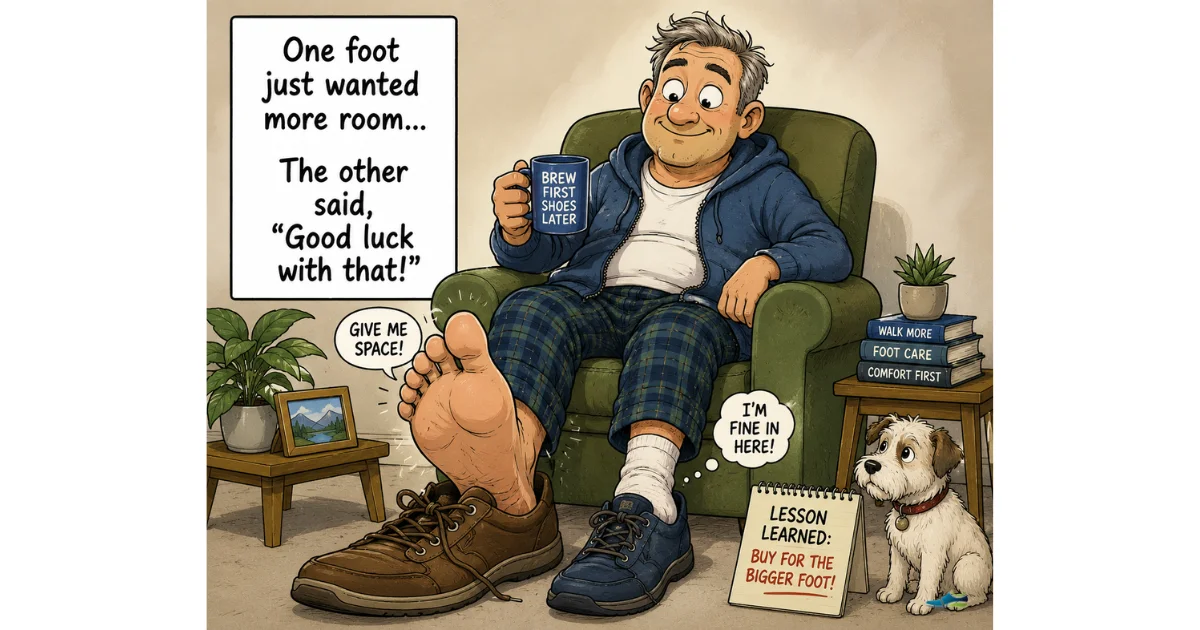
For most people, it’s completely normal. In fact, it’s more common to have one foot that’s slightly larger than the other than two feet that are exactly the same size. And if you’re buying shoes, always fit the larger foot. It’s much easier to make a shoe fit a slightly smaller foot than it is to squeeze a bigger one into a shoe that’s too small.
Affiliate disclosure: This article contains affiliate links. If you buy something through one of these links, I may earn a small commission at no extra cost to you.
Right, can I let you into a little secret?
If you’ve ever taken one shoe off at the end of the day and thought, “I’m sure one foot feels more cramped than the other,” you’re not imagining it.
In fact, it’s so common that I’d be very surprised if both your feet were exactly the same size.
This came as news to me.
Like loads of people, I’d always assumed our feet came as a perfectly matched pair. Two feet, two shoes and one shoe size. Simple.
Well… not quite.
The more I learned, the more I realised our bodies aren’t built with rulers and tape measures. Just as one hand is often a little bigger than the other, one foot usually is too. Most of the time the difference is small enough that we never notice it, but sometimes it’s enough to make one shoe feel absolutely fine while the other feels as though it’s got a grudge against us.
So, which foot should you buy shoes for?
This is where so many of us get caught out.
If one foot is slightly smaller, it’s very tempting to choose shoes that fit that one perfectly because they feel lovely in the shop. The trouble is, it’s the larger foot that will suffer without enough room.
I’d much rather have one shoe that’s ever so slightly bigger, than spend the day wishing I’d given my bigger foot a little more breathing space.
It’s a bit like buying a pair of gloves because one hand feels wonderful, while the other can hardly bend its fingers. It doesn’t really make much sense when you stop and think about it.
As a general rule, always buy shoes to fit your larger foot. If your smaller foot needs a little extra support or adjustment, it’s usually much easier to deal with than trying to persuade your bigger foot to squeeze into a shoe that’s simply too small.
Why does one foot become bigger?
So why does it happen?
Sometimes we’re simply born that way, and we’ve been walking around with slightly different-sized feet for years without ever realising it. Other times, the difference becomes more noticeable as we get older, particularly if arthritis, swelling or an old injury has affected one foot more than the other.
Even something as simple as favouring one leg after an injury can change the way we stand and walk over time.
The important thing to remember is that it isn’t unusual. In fact, it’s probably far more unusual to have two feet that are exactly the same size.
Can a change in foot size be temporary?
Yes and no…….
Some medication can cause your feet to swell, it’s a common side effect, that doesn’t mean that you have to put up with it though. It’s worth mentioning it to your GP because there may be an alternative medication that doesn’t affect your feet in the same way.
Foot or ankle surgery can have a huge impact on foot size, swelling generally lasts for 12 to 18 months, sometimes longer, and unfortunately, sometimes forever. Your surgeon will always try advise you further.
It is very important that you wear supportive shoes following surgery, so although a new pair of shoes will likely be needed (and maybe only temporarily) don’t skimp on this pair, they’re necessary for adequate healing and keeping stress and strain from the joints.
Don’t let one uncomfortable shoe fool you
I think we’ve all had a pair of shoes where one foot felt perfectly happy while the other seemed desperate to get out?
Your shoes aren’t necessarily the wrong size.
They’re just trying to fit two feet that aren’t exactly the same.
Many of us have different sized feet, sometimes one foot is wider than the other, sometimes one foot is longer than the other
Now I understood that, I’ve stopped expecting every pair of shoes to feel identical on both feet. Instead, I started paying much more attention to how my larger foot felt because that’s usually the one that tells you whether you’ve chosen the right fit.
And, if I’m honest, it’s saved me from making more than a few expensive mistakes.
What if one foot is quite a bit bigger than the other?
For most of us, the difference is fairly small, so buying shoes to fit the larger foot works perfectly well. Every now and then, though, the difference is much more noticeable, and that’s when finding comfortable shoes can become a real challenge.
If that’s you, don’t be tempted to squeeze your larger foot into a smaller shoe just to keep the other one happy. It rarely ends well. Your bigger foot is the one that’s most likely to complain, and before long you’ll probably be blaming the shoes when they’ve never really had a fair chance.
Instead, look for footwear with a deeper toe box, adjustable fastenings or removable insoles, as these can often make it much easier to accommodate the larger foot without leaving the other flopping up and down.
I regularly buy shoes with removable insoles. My right foot is the bigger one, so I take that insole out and leave the other one exactly where it is. It gives me the extra room I need, nobody can tell, and both shoes are still the same size.
Only I know, because it isn’t visible.
What I’d Actually Look For
If you’re using the removable-insole trick like I do, a spare, good-quality insole is worth having on hand for the smaller foot’s shoe once you’ve taken the other one out — it keeps that shoe supportive rather than just leaving it empty inside.
Is it worth measuring both feet
Here’s something I wish I’d known years ago.
When you’re having your feet measured, don’t just pop one foot on the measuring device and assume the other one will be identical. Measure both.
It only takes a minute, but it could save you buying the wrong size altogether. If one foot is half a size bigger, that’s useful information to have before you start trying shoes on rather than after you’ve worn them around the house.
Most good shoe shops will happily measure both feet, and if you’re measuring them yourself at home, it’s well worth double checking each one separately.
Remember, measure twice, buy once.
Read The complete guide to finding the perfect fit
Shoes should fit your feet, not the other way round
I think we’ve all been guilty of trying to make our feet fit the shoes instead of expecting the shoes to fit our feet, particularly when we’ve fallen in love with a style or colour. We convince ourselves they’ll stretch, tell ourselves they’ll soften and sometimes even hope our feet will somehow shrink to get in them.
Looking back, it’s a bit like buying a hat that’s too small and hoping your head fits in it. When you say it out loud, it sounds ridiculous, yet we’ve all done something very similar with shoes.
The right pair shouldn’t need persuading.
They should feel comfortable from the start.
Find out why going up a size doesn’t work
So, should you worry if one foot is bigger?
In most cases, no.
It’s a perfectly normal part of being human, and millions of people have one foot that’s slightly larger than the other. The important thing isn’t trying to make them identical. It’s choosing footwear that gives both feet the room and support they need.
If, however, one foot suddenly becomes much larger than the other, or the difference is accompanied by pain, significant swelling or a noticeable change in shape, it’s sensible to have it checked by a healthcare professional. A sudden change is very different from the gradual differences that many of us have had for years.
The Bottom Line
Finding out that one foot is bigger than the other isn’t all bad news.
If anything, it explains why you’ve sometimes struggled to find shoes that feel comfortable on both feet at the same time.
Once I accepted that my feet weren’t identical, I stopped expecting every pair of shoes to fit perfectly straight out of the box. Buying shoes to fit my larger foot and choosing styles with enough room where it really mattered made far more difference than I anticipated.
If you’ve always wondered why one foot is bigger than the other, you’re certainly not alone. Once you understand it’s perfectly normal, choosing comfortable shoes becomes much easier.
Frequently Asked Questions
Q: Is it normal for one foot to be bigger than the other?
A: Yes. Most people have one foot that’s slightly larger than the other. The difference is usually small, but it’s completely normal.
Q: Which foot should I measure when buying shoes?
A: Measure both feet and buy shoes to fit the larger one. It’s much easier to make a shoe fit a slightly smaller foot than to squeeze a larger foot into a shoe that’s too small.
Q: How much difference in foot size is normal?
A: A small difference is very common. Many people have one foot that’s slightly longer or wider than the other without ever noticing until they begin looking for better-fitting shoes.
Q: Can arthritis or swelling make one foot bigger?
A: Yes. Arthritis, swelling, previous injuries and some medical conditions can make one foot larger or change its shape over time.
Q: When should I seek medical advice?
A: If one foot suddenly becomes much larger than the other, or the change is accompanied by pain, severe swelling, redness or changes in skin colour, it’s important to seek medical advice to rule out an underlying problem.
About Sue Holland
Hi, I’m Sue.
For years, I struggled to find shoes that were genuinely comfortable. Living with arthritis, flat feet and chronic swelling, I know from first-hand experience just how much the wrong footwear can affect everyday life. I’ve also had two hip replacements and two ankle replacements, so finding supportive, well-fitting shoes isn’t just a hobby for me – it’s something I’ve had to learn the hard way.
That’s why I created WiderFittingShoes.com.
My aim is simple: to share honest, practical advice that helps other people find comfortable footwear without wasting money on shoes that never quite fit. Everything I write is based on my own experience, careful research and a genuine desire to make choosing the right shoes a little easier.
Disclaimer: The information on WiderFittingShoes.com is based on personal experience and independent research. It is intended for general information only and should not be taken as medical advice or a substitute for professional healthcare. Everyone’s feet and medical circumstances are different. If you have persistent foot pain, sudden swelling, changes in the shape of your feet or any concerns about your health, please speak to your GP, podiatrist or another qualified healthcare professional. Always follow the advice of your own healthcare team regarding diagnosis and treatment.