
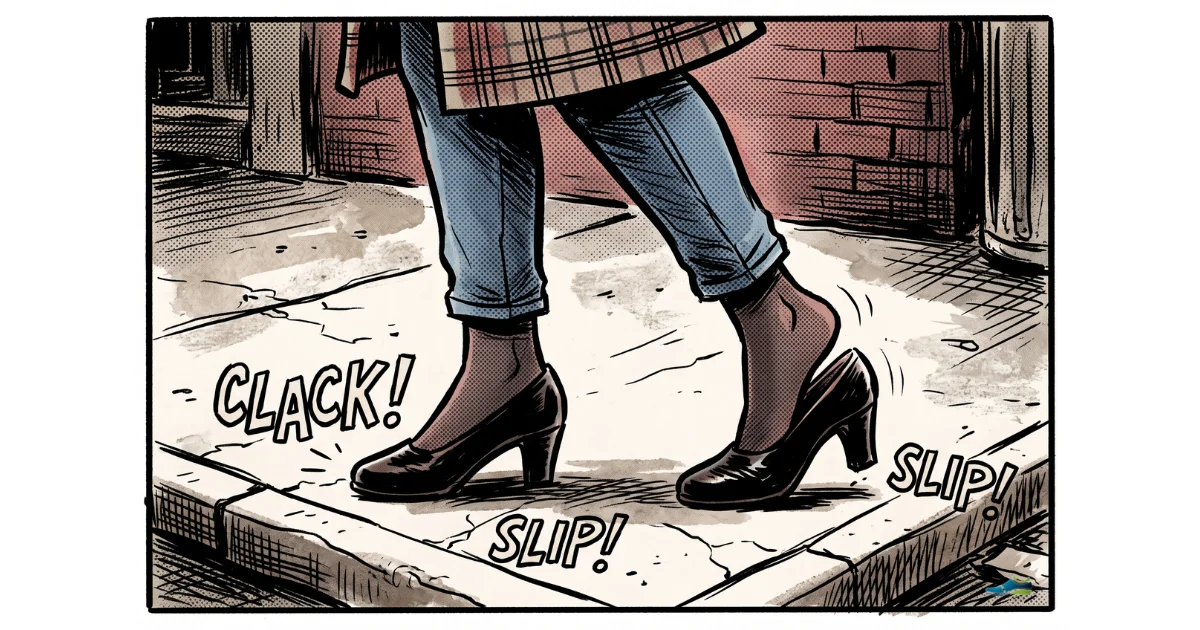
My own feet are wide right through — forefoot, heel, the lot — so for years I assumed “wide fit” was a simple, one-size-fits-all fix. It took hearing from readers with a very different problem to realise it isn’t. If you’ve got a genuinely wide forefoot but a narrower, well-defined heel, a “wide fit” shoe can still let you down — just in a different way. Instead of pinching your toes, it lets your heel slide around inside a shoe that was scaled up evenly rather than shaped for your actual foot.
Affiliate disclosure: This article contains affiliate links. If you buy something through one of these links, I may earn a small commission at no extra cost to you.
Why This Happens
Most “wide fit” shoes are built by taking a standard last (the mould a shoe is shaped around) and simply widening it evenly, right through the heel as well as the toes.
That works well if your whole foot is proportionally wide, which is genuinely my situation. But if your heel is narrower relative to your forefoot, that same evenly-widened shoe leaves you with room where you need support, and support where you don’t need it.
When the rear structure of a shoe fails to grip your heel securely, your foot naturally lifts away from the footbed with every single step. This constant vertical slipping creates intense localized friction heat inside the back cup, leading to raw skin patches and deep underfoot blisters.
Having lived with severe joint wear and tear and managed prolonged recoveries after extensive orthopaedic surgeries, I know first-hand that a loose heel counter handles mechanical stress incredibly poorly. It forces your foot to constantly “claw” the insole to stay inside the shoe chamber, throwing off your walking pattern and causing premature muscle fatigue by evening.
Resolving this alignment challenge requires choosing footwear built on specialized combination lasts. Opting for styles engineered with a broad, high-volume forefoot but an independently narrow heel cup is the most direct way to anchor your rearfoot securely, stabilizing your stride, preventing friction tracking, and protecting your fragile skin boundaries from painful tendon rubbing.
What Actually Helps
- A structured heel counter — the firm cup at the back of the shoe that holds your heel in place. Look for one that feels genuinely snug, not just padded.
- Adjustable lacing — a heel-lock or lacing technique, where you thread the laces through the top eyelets to create a loop that cinches the heel snugly, can dramatically reduce slip without needing a different shoe at all. Worth trying before assuming you need to size down or buy something new. Runner’s Loop A lacing technique that uses the top eyelets to create two small loops, which you cross and pull to lock your heel snugly in place.
- Brands with combination lasts — some manufacturers shape the heel and forefoot independently rather than scaling one width evenly, which is exactly what this problem needs. Worth asking directly, or checking a brand’s own sizing notes, rather than assuming “wide” always means the same thing.
- Heel grips or pads — a simple, cheap fix if the shoe is otherwise right but just needs a touch more hold at the back.
What I’d Actually Look For
If lacing alone doesn’t quite solve it, a good pair of heel grips can make a real difference — they add just enough cushioning at the back to stop your heel lifting, without changing how the rest of the shoe fits. Dr.Foot’s self-adhesive heel grips are a solid, well-reviewed option worth starting with.
Sizing Guidance: Make sure to check the physical thickness dimensions and adhesive boundary scales on the manufacturer’s packaging to confirm the pad profile fills the rearfoot void comfortably without crowding your toes forward.
Check Dr.Foot heel grips on Amazon
How to Tell If This Is Your Problem
If your toes finally have room but your heel lifts when you walk, or you find yourself tightening laces more and more just to stop your foot sliding forward, this combination is very likely what’s going on — not a sign you need an even wider shoe, which usually makes the heel slip worse, not better.
If you haven’t already, it’s worth properly measuring both your forefoot and heel separately rather than assuming one width covers both — my guide to measuring foot width at home covers the basics, though for this specific issue, comparing your heel measurement against your forefoot measurement is the key extra step.
Frequently Asked Questions
Can I have wide feet and a narrow heel at the same time?
Yes, it’s a genuine and fairly common foot shape. It’s just less talked about than uniformly wide or uniformly narrow feet, so it’s often overlooked by both shoe brands and shoppers.
Why does my heel slip even in wide fit shoes?
Most wide fit shoes widen the entire shoe evenly, including the heel. If your heel is narrower than your forefoot, that extra room becomes a problem rather than a solution.
Will going up a size fix heel slip?
Usually not, and it can make it worse — a bigger shoe often means even more room around the heel. A better fit or a lacing adjustment is generally more effective than sizing up.
Medical Disclaimer: The footwear fitting parameters, structural last definitions, and conservative lacing adjustments compiled across this guide are provided strictly for general informational and educational purposes. They do not constitute personalized professional medical advice, clinical diagnosis, or distinct orthopedic treatment frameworks. Persistent rearfoot blistering, chronic ankle instability, or sharp pain along the rear heel cord require direct professional assessment and evaluation by a qualified GP, podiatrist, or sports medicine specialist.