
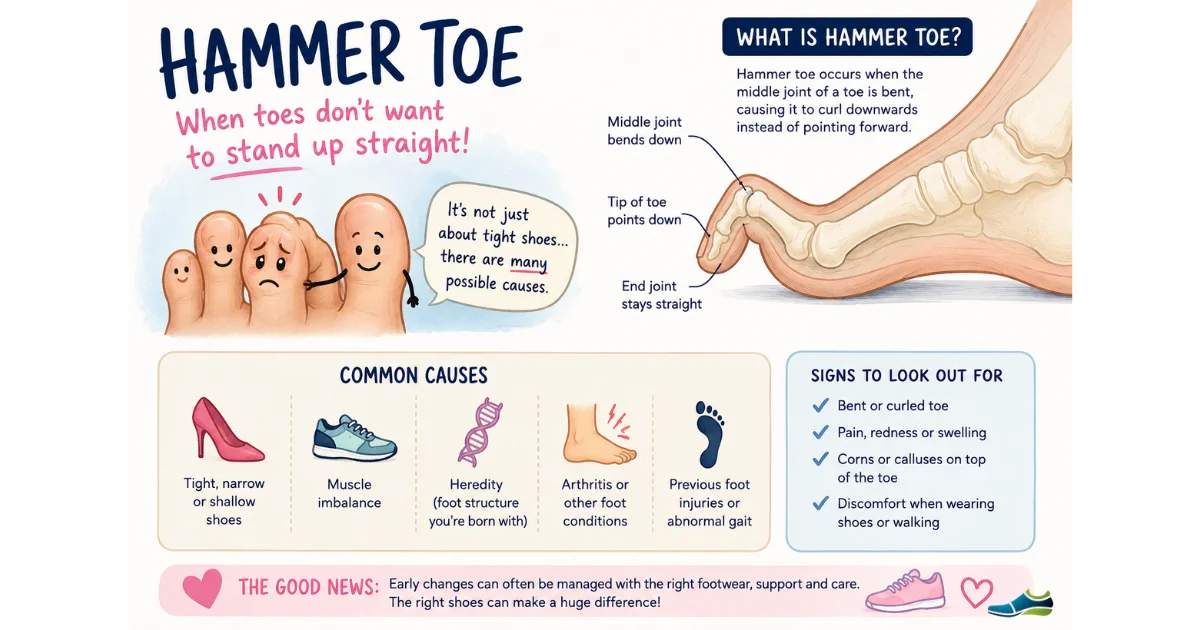
Not usually on their own. Tight shoes can certainly make hammer toes worse and, in some people, may help them develop sooner, but they’re rarely the whole story. Foot shape, age, arthritis, muscle imbalance and the shoes you wear can all play a part.
When something changes with your feet, it’s funny where your mind goes first.
You spot a toe that’s started to bend instead of lying flat. It rubs on the top of your shoe, catches on your socks, or just doesn’t look quite right anymore. Then, almost without thinking, you glance down at your shoes and wonder…
“Have I done this to myself?”
It’s a question I hear time and time again, and it’s a perfectly reasonable one to ask.
After all, we’ve all squeezed our feet into shoes that looked better than they felt at some point in our lives. Whether it was smart work shoes, fashionable heels, or simply a pair that seemed comfortable enough in the shop but became torture after a few hours, most of us have been there.
So, are tight shoes really to blame for hammer toes?
Well… yes and no.
They can certainly make the problem worse, and in some people they may help it develop sooner. But they’re rarely the whole story.
Like many foot problems, hammer toes usually happen because several things come together over time. Your foot shape, your muscles and tendons, your age, arthritis and, yes, the shoes you wear can all play a part.
Understanding what may be contributing is useful because it can help you make better choices about footwear and know when it’s worth getting professional advice.
Let’s have a proper look.
What Exactly Is a Hammer Toe?
Despite the name, nothing has actually been hit with a hammer.
A hammer toe is a toe that bends at the middle joint instead of lying straight. It most commonly affects the second toe, although the third and fourth toes can also be affected.
In the early stages, you may still be able to straighten the toe with your fingers. As it progresses, the toe can become stiffer and may eventually remain bent.
That’s when everyday things can start becoming irritating.
The top of the toe may rub against your shoe, or a corn can develop where the skin is repeatedly under pressure. Walking can become uncomfortable, and finding shoes that don’t rub suddenly becomes much harder.
It’s often a gradual change rather than something that appears overnight, which is why you may not notice it until it becomes quite obvious.
Hammer toes are sometimes confused with claw toes and mallet toes. Although they’re related conditions, they’re slightly different because they affect different joints in the toes. If you’re unsure what’s causing a toe to bend, a podiatrist can assess it properly.
Ok…..Do Tight Shoes Cause Hammer Toes?
This is where things get a little more interesting.
If you already have feet that are naturally prone to hammer toes, constantly squeezing them into narrow shoes isn’t doing them any favours.
Imagine trying to keep your fingers straight while wearing gloves that are two sizes too small. You’d immediately understand how the lack of space was forcing them into an unnatural position.
A cramped toe box can do something similar to your toes. Repeatedly forcing them into a restricted position may contribute to problems over time, particularly if you’re already prone to developing hammer toes.
But, and it’s quite an important “but,” millions of people have worn tight shoes without ever developing hammer toes. Equally, plenty of people who have hardly worn narrow shoes at all still develop them.
That tells us something. Shoes alone are rarely the entire cause. Instead, they often act as one piece of a much bigger jigsaw.
Read The Truth about Foot Width (and why going up a size doesn’t work)
Other Things That Can Lead to Hammer Toe
Our feet are remarkably complex. Each toe relies on muscles, tendons, ligaments and joints all working together.
If that balance changes, the toe can gradually begin to curl. Several factors can increase the likelihood.
Your Foot Shape
Some people have a foot shape that may make hammer toes more likely.
A relatively long second toe, high arches and other differences in foot structure can all affect how your toes sit and move inside your shoes.
You can’t change the basic shape of your feet, but understanding it can help explain why some people are more prone to problems than others.
Muscle Imbalances
Muscles and tendons work together to control the position and movement of your toes. If that balance changes, a toe can gradually begin to bend.
This is one reason hammer toes can develop slowly, sometimes without becoming obvious until they start rubbing or becoming uncomfortable.
Arthritis
Arthritis changes joints throughout the body, and the small joints in the toes are no exception.
Inflammation, stiffness and changes in joint movement can all contribute to toes gradually changing position.
Getting Older
Hammer toes become more common with age. Changes in the muscles, tendons and joints of the feet over the years can all contribute, although getting older certainly doesn’t mean you’re destined to develop them.
Diabetes and Nerve Problems
Diabetes and certain nerve conditions can affect the muscles that control your toes. If those muscles become weakened or unbalanced, the toes may gradually change position, sometimes developing deformities such as hammer toes.
If you have diabetes and notice any change in the shape of your feet or toes, it’s worth mentioning it to your GP, diabetes nurse or podiatrist sooner rather than later.
Why Are Hammer Toes More Common in Women?
Hammer toes are more commonly seen in women, and footwear may be one of the contributing factors.
High heels can push the foot forwards, while narrow or pointed toe boxes squeeze the toes into a smaller space. Wearing shoes like this regularly can put additional pressure on toes that may already be prone to bending.
Thankfully, choosing comfortable shoes doesn’t mean resigning yourself to something you’d never normally wear. There are now far more attractive options with wider and deeper toe boxes than there used to be.
And that’s good news for everyone’s feet.
Can Hammer Toes Be Reversed?
It depends largely on whether the toe is still flexible or has become fixed in position.
In the earlier stages, you may still be able to straighten the toe with your fingers. Changing footwear can help by giving the toes more room and reducing rubbing and pressure, but that doesn’t necessarily mean the underlying hammer toe has been reversed.
Once a hammer toe has become rigid and can no longer be straightened manually, simply changing shoes won’t make it straight again. At that stage, a podiatrist or other appropriate healthcare professional can assess the toe and explain what treatment options may be suitable.
Either way, there’s no reason to wait until a hammer toe becomes extremely uncomfortable before doing something about footwear that’s rubbing or squeezing it.
Why Wider-Fitting Shoes Can Make Such a Difference
If you’ve reached the point where your hammer toe is rubbing on the top of your shoe every time you walk, you’ll know just how miserable it can become.
The first instinct is often to buy the next size up. I understand why. I did exactly the same thing for years whenever a pair of shoes felt tight. The trouble is, making a shoe longer doesn’t usually give your toes the extra room they’re crying out for.
Instead, your foot slides forwards every time you walk, your toes still end up cramped in the front, and you’ve now got the added bonus of your heel moving about as well. It’s a lose-lose situation.
A properly fitting shoe with enough width and toe-box depth works differently.
Rather than simply making the shoe longer, you’re looking for enough space across the forefoot and above the toes, so they aren’t being squeezed together or pressed against the upper.
That doesn’t mean the right shoe will straighten an established hammer toe. What it can do is give the toes more room and reduce the rubbing and pressure caused by cramped footwear.
Sometimes that relatively simple change can make a surprisingly big difference to everyday comfort.
My article on the benefits of wide fit shoes may be a useful read.
What Should You Look For In A Shoe?
If hammer toes are making life uncomfortable, choosing the right shoe becomes less about fashion and much more about giving your feet a fighting chance.
One of the biggest things to look for is a deep toe box.
People often hear the words “wide fit” and immediately think about width across the ball of the foot. That’s only part of the story. Hammer toes don’t just need room from side to side. They often need extra height as well.
If the top of a bent toe is rubbing against the inside of the shoe, extra width alone may not solve the problem. A generous, deeper toe box gives the toes more vertical space and reduces contact with the upper.
Soft uppers can also make a surprising difference. Leather that gradually moulds to your foot, stretchy textile uppers or footwear designed with extra give can be more accommodating around prominent toes.
And don’t underestimate the importance of fastening.
Laces and adjustable straps let you fine-tune the fit, which can be particularly useful if your feet change in size during the day.
“If you’re at the stage where you’re looking for footwear recommendations, I’ve put together a separate guide covering exactly what to look for and some of the best shoe styles for hammer toes.
Common Mistakes People Make
I’ve lost count of the number of times I’ve heard people say, “I’ll just put up with it.” The trouble is, our feet rarely reward us for ignoring problems.
Another common mistake is buying shoes because they feel comfortable while you’re sitting in the shop. Walking around for thirty seconds on a carpet isn’t quite the same as spending six hours shopping, working or walking the dog.
If your feet tend to swell as the day goes on, it’s worth bearing that in mind when trying on shoes. A pair that feels perfect first thing in the morning may feel very different after you’ve been on your feet for several hours.
And please don’t fall into the trap of buying an uncomfortable pair and hoping they’ll “stretch enough eventually.” Some shoes will soften or give a little with wear, but they won’t magically turn into a completely different width or shape.
If a shoe is only slightly tight, my guide to the best shoe stretchers for toe box relief explains the different ways you can create a little extra room.
Can You Prevent Hammer Toes?
Not every hammer toe can be prevented. Foot shape, arthritis, age and other factors may all play a part, so there’s no guarantee that changing your footwear will stop one from developing.
What you can do is avoid unnecessarily crowding your toes. Choosing shoes with enough width and depth gives them room to sit more naturally instead of repeatedly being squeezed into a cramped toe box.
It’s also worth paying attention when something changes.
If a toe is beginning to curl, repeatedly rubs against your footwear or becomes uncomfortable, don’t simply assume you have to put up with it. Check whether your shoes are contributing to the pressure and seek professional advice if the problem persists or concerns you.
When Should You Seek Professional Advice?
It’s sensible to seek professional advice if a hammer toe is becoming painful, getting noticeably worse or affecting the way you walk.
You should also get it checked if you develop an open sore, persistent corn, increasing redness or swelling, particularly if you have diabetes, reduced sensation or known circulation problems.
Those are situations where it’s better to get advice rather than simply waiting to see what happens.
A podiatrist can assess the toe, including whether it’s still flexible or has become fixed, and advise you about appropriate footwear and other treatment options if they’re needed.
Surgery is one possible treatment for some hammer toes, but whether it’s appropriate depends on the individual problem. If symptoms are severe or other measures haven’t helped, that’s something to discuss with an appropriate specialist.
The Bottom Line
If you’re wondering whether tight shoes caused your hammer toes, the honest answer is that they’re probably only part of the story.
For many people, hammer toes develop because several factors come together over many years. Foot shape, ageing, muscle imbalance, arthritis and footwear can all have their part to play.
The important thing isn’t dwelling on what’s already happened. It’s deciding what to do next.
Giving your toes enough room and choosing shoes with a wider, deeper toe box can reduce the pressure and rubbing caused by cramped footwear. And if a toe is changing shape, becoming painful or causing you concern, it’s worth getting professional advice rather than simply putting up with it.
Your feet carry you through thousands of miles during your lifetime. Looking after them isn’t a luxury.
It’s one of the best investments you can make in your future comfort.
Frequently Asked Questions
Q: Can wearing tight shoes alone cause hammer toes?
A: Usually not. Tight shoes may contribute to hammer toes, particularly if you’re already prone to developing them, but they’re rarely the only factor. Foot shape, arthritis, age and changes in the muscles and tendons can all play a part.
Q: Will switching to wide-fit shoes straighten a hammer toe?
A: No. A wider or deeper-fitting shoe won’t straighten an established hammer toe, but it can give the toes more room and reduce pressure and rubbing from the shoe.
Q: What’s the difference between a wide fit and a deep toe box?
A: A wide-fit shoe provides extra room across the width of the foot, while a deep toe box provides extra height above the toes. If you have hammer toes, you may need to consider both width and depth when choosing footwear.
Q: Can hammer toes be reversed without surgery?
A: It depends on the individual toe and whether it’s still flexible or has become fixed. Changing footwear can reduce pressure and rubbing, but it doesn’t necessarily reverse the underlying problem. A podiatrist can assess the toe and explain what treatment options may be appropriate.
Q: Are hammer toes always painful?
A: No. Some people initially notice only that a toe has changed position. Discomfort can develop if the bent toe begins rubbing against footwear or pressure causes a corn or sore area.
Medical Disclaimer: This article is for general information only and isn’t a substitute for medical advice, diagnosis or treatment. Hammer toes can have several causes, and footwear changes won’t correct every case. If a toe is painful, changing shape or causing persistent problems — particularly if you have diabetes, reduced sensation or circulation problems — seek advice from an appropriate healthcare professional or podiatrist.
Sources / Further Reading
Royal College of Podiatry – Toe Deformities
About Sue Holland
Sue writes WiderFittingShoes.com from first-hand experience of finding footwear for wide and difficult-to-fit feet. After two hip replacements, two ankle replacements and years of dealing with arthritis, swelling and feet that don’t always behave the same from one day to the next, she shares the practical things she’s learned about shoe fit, width and comfort.