
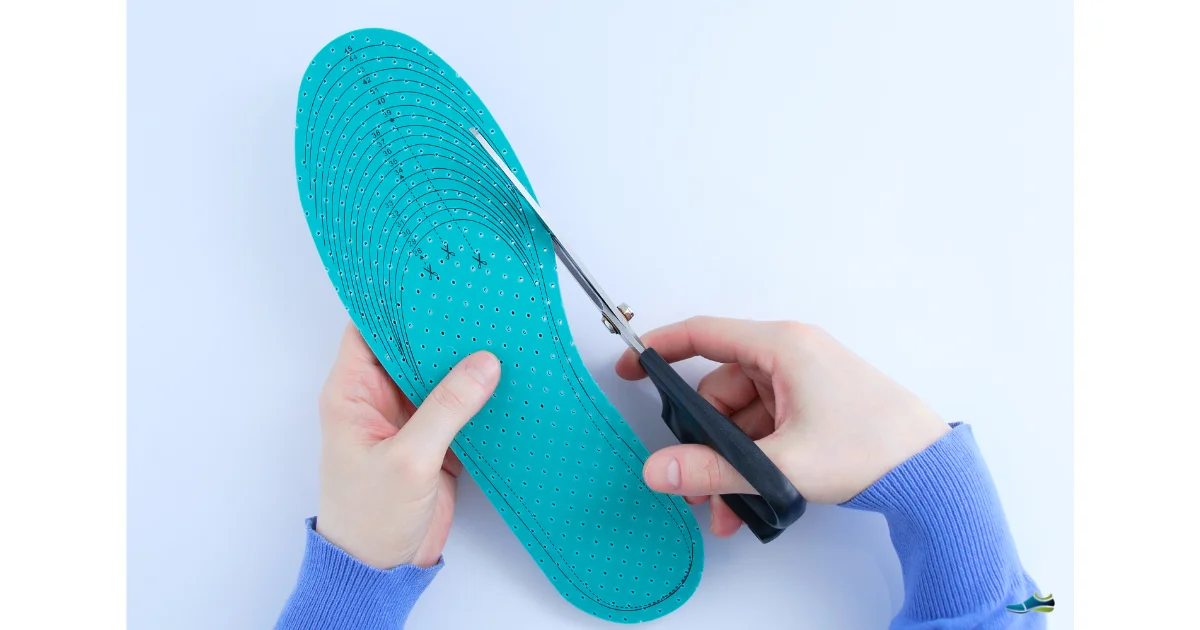
Here’s something that took me a surprisingly long time to realise: buying wide fit shoes doesn’t automatically mean everything inside them is wide too. The insole — the bit your foot actually sits on — is usually still cut to a standard shape, even inside a wide shoe.
I came across this properly while looking into spare insoles for my own “one bigger foot” trick (I’ve written about that here), and it made me realise it’s worth its own explanation.
Standard arch supports are almost exclusively manufactured on narrow, contoured templates that fail to fill the base of a wide-fitting shoe.
When an insert sits loosely inside an extra-depth shoe bed, the foot naturally slides sideways under load, causing your heel to spill right over the edge of the support boundary. Having navigated extensive joint wear and tear and managed prolonged post-operative rehabilitation timelines, I know first-hand that underfoot instability handles mechanical stress incredibly poorly, leading to deep structural fatigue by evening.
Squeezing a narrow insert into a wide shoe chamber forces the arch contour to mash down incorrectly, creating painful friction points against the sole of your foot. Resolving this alignment mismatch requires choosing structural insoles specifically cut to fill a high-volume shoe base.
Choosing full-width profiles ensures the support perimeter remains perfectly flat under your foot, anchoring your heel securely, preventing lateral slippage, and protecting your skin boundaries from painful edge chafing.
Affiliate disclosure: This article contains affiliate links. If you buy something through one of these links, I may earn a small commission at no extra cost to you.
Why a Standard Insole Doesn’t Quite Work in a Wide Shoe
A standard-width insole is shaped to fill a standard-width shoe. Put it inside a wide fit shoe and it simply sits in the middle, leaving gaps at the sides. That might not sound like a big problem, but it means the insole can’t properly support your arch or heel the way it’s designed to — because it isn’t actually touching the full width of your foot.
Over time, this can mean your foot slides around slightly inside the shoe even though the shoe itself fits, or that an insole you’d otherwise get on well with just doesn’t feel quite right once it’s in a wider shoe.
Do You Actually Need One?
Not everyone in a wide fit shoe needs a wide fit insole specifically — if your shoes already feel genuinely supportive and stable, there’s no need to change anything. But it’s worth considering a wide fit insole if:
- You’ve bought wide fit shoes but still feel like your foot moves around inside them
- Your current insole feels like it’s bunching, curling at the edges, or not sitting flat
- You need arch support but a standard insole hasn’t felt right in your wide shoes
- You’re in the EE to 4E-6E width range specifically, where the gap between insole and shoe becomes more noticeable
What I’d Actually Look For
Superfeet’s Wide Fit range comes up repeatedly as the genuinely established option here — properly shaped for wide-width shoes rather than a standard insole with “wide” stuck on the label, and available in a real width range (3E to 6E).
Sizing Guidance: Because structural arch placements vary between orthotic manufacturers, always check the physical sizing scales and structural width charts on the manufacturer’s packaging to confirm the insert contour comfortably accommodates your unique foot profile.
Check Superfeet Wide Fit insoles on Amazon
Frequently Asked Questions
Is a wide fit insole the same as a regular insole in a bigger size?
No. It’s shaped differently across the width, not just scaled up in length, so it properly fills a wide shoe rather than sitting in the centre with gaps at the sides.
Do all wide fit shoes need a wide fit insole?
Not necessarily. If your current shoes and insoles already feel supportive and stable, there’s no need to change them. It’s worth considering if you notice your foot moving around or the insole not sitting flat.
Medical Disclaimer: The footwear fitting parameters, structural insert width metrics, and conservative underfoot stability suggestions compiled across this guide are provided strictly for general informational and educational purposes. They do not constitute personalized professional medical advice, clinical diagnosis, or distinct orthopedic treatment frameworks. Persistent midfoot arch pain, chronic lower limb misalignment, or severe walking discomfort require direct professional assessment and evaluation by a qualified GP, podiatrist, or orthopedic specialist.