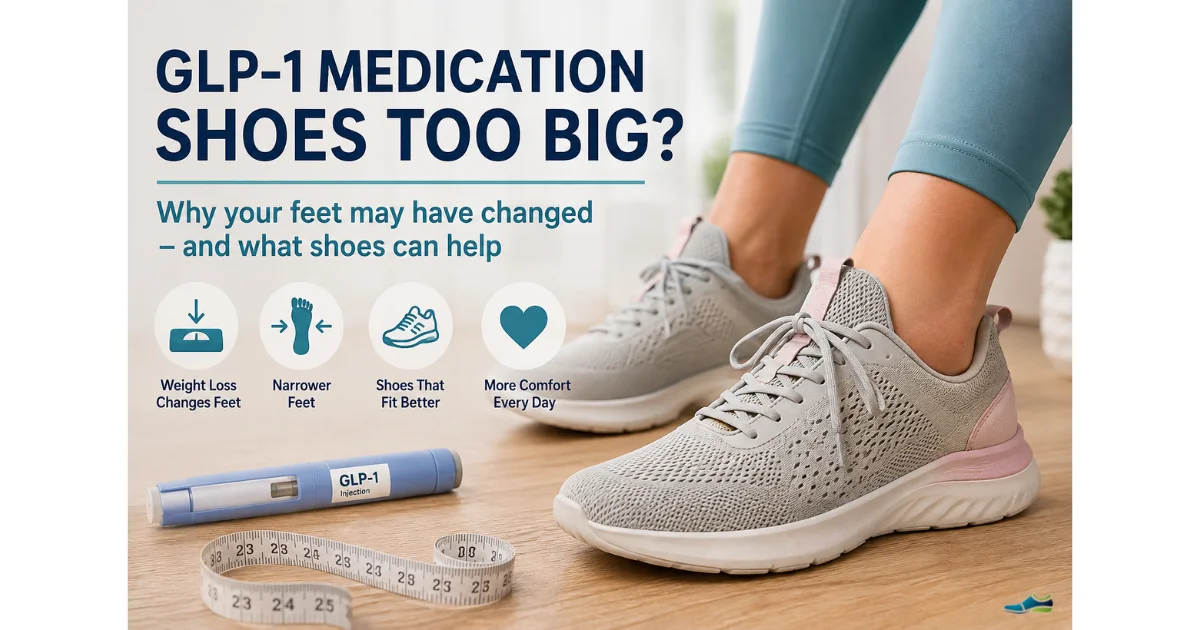
If your shoes have suddenly started slipping at the heel or feeling strangely roomy after losing weight, you may not be imagining it. Significant weight loss can make your feet slimmer and reduce their overall volume, leaving shoes that once fitted perfectly feeling too big.
The subject has recently attracted attention under the catchy name “Ozempic feet”, after some people using GLP-1 medications such as Ozempic, Wegovy and Mounjaro reported changes in how their shoes fit.
But there’s an important distinction.
While localized user testimonies frequently highlight rapid shoe fit variations following the initiation of specialized GLP-1 therapies, there is no conclusive clinical evidence proving that these pharmaceutical agents directly shrink the skeletal structure of the foot.
Forcing a high instep profile into standard fashion footwear is a surefire way to trigger severe under-lace compression and deep skin irritation. When a shoe lacks sufficient vertical clearance, the stiff tongue and throat materials press directly against the prominent bone ridge on the top of the foot, leaving angry red indentations across your skin after only a few minutes of walking.
My decades of navigating complex lower-limb reconstructions and managing severe arthritic changes have taught me that the dorsal aspect of the foot handles vertical mechanical pressure incredibly poorly, as it is packed with highly sensitive surface nerves. Managing this painful constriction safely requires stepping away from traditional footwear shapes.
While trying alternative parallel lacing patterns or choosing stretchable fabric uppers offers excellent temporary relief, the real secret to lasting mobility lies in selecting shoes built on dedicated extra-depth lasts. Opting for high-volume chassis designs ensures your foot has the true vertical room it needs to rest naturally without being squashed by stiff outer edges, completely eliminating focal friction points and protecting your skin from painful rubbing.
So what is actually happening — and what should you do if your favourite shoes suddenly feel a size too big?
Can Your Feet Really Get Smaller When You Lose Weight?
Yes, they can — although that doesn’t necessarily mean your feet have become dramatically shorter. We tend to think of shoe size as heel-to-toe length, but there’s much more to a good fit than that. A shoe also has to accommodate the width, circumference and overall volume of your foot.
Lose some of that volume around the forefoot, heel or instep and the same shoe can suddenly feel considerably larger, even if your foot length hasn’t changed very much, and there is research to back this up.
One study used 3D foot scanning to examine adults before and after a 12-week weight-reduction programme. After an average weight loss of around 7.5kg, researchers found significant reductions in measurements including forefoot girth, rearfoot width and instep girth.
Put simply, their feet became thinner.
Other research has found that adults with obesity tend to have greater foot width, heel width and foot circumference than adults of a healthy weight. Many would argue your feet are being squashed.
So it makes perfect sense that substantial weight loss could change the way your existing shoes fit.
Read my article Wide Shoe Widths Explained which includes width size tables to help decide on shoe fit.
What Are “Ozempic Feet”?
“Ozempic feet” is not a recognised medical diagnosis.
It’s a nickname that has appeared alongside phrases such as “Ozempic face” to describe physical changes that some people have noticed after substantial weight loss while using GLP-1 medications.
Reports include shoes becoming too big, people needing a smaller shoe size and, interestingly for us here at WiderFittingShoes.com, some people finding they no longer need the same width fitting.
Medical experts quoted recently about the phenomenon have said that these changes are likely associated with the loss of fat, muscle and general tissue volume that can accompany major weight loss, rather than being a direct effect of the drug on the feet.
That distinction matters.
You don’t have to take Ozempic — or any other GLP-1 medication — for losing a significant amount of weight to affect your feet.
Sue’s Experience
My own shoes are noticeably looser than they used to be.
I have lost weight, which may well be part of the reason, but in my case there’s another possible explanation. I’ve had both ankles replaced, and as more time has passed since those operations, some of the swelling I used to have may also have reduced.
I’ve used a GLP-1 medication in the past too, but I certainly couldn’t say that was responsible for the change in my shoe fit. In fact, if anything, I remember my feet being more swollen at the time.
What I can say is that shoes which once fitted me properly now feel noticeably roomier. And I think that illustrates something important about the whole “Ozempic feet” story.
If your shoes suddenly feel bigger, don’t automatically assume the medication has shrunk your feet. Weight loss, changes in swelling and other individual factors may all affect how your shoes fit.
There’s also another possibility, if you wear memory foam shoes, they may need replacing, once the foam loses it’s bounce back, shoes can feel looser. Read my guide on How long Memory Foam Shoes Last
Why Do Shoes Become Too Big After Weight Loss?
There can be several things going on at once.
Your Feet May Become Narrower
This is perhaps the most interesting change if you normally wear wide-fitting shoes.
If the circumference of your forefoot and instep decreases, there’s simply less foot filling the shoe. A wide-fitting shoe that previously felt comfortable can therefore start feeling sloppy. You might notice your foot moving from side to side or suddenly find yourself pulling laces and straps much tighter than before.
Your Heels May Start Slipping
Reduced volume around the rear of the foot can leave more space inside the heel cup.
Your heel then lifts as you walk. A little movement is one thing, but excessive heel slipping can cause rubbing and blisters and is a good indication that the shoe no longer fits as it should.
Swelling May Have Changed
This one is particularly easy to overlook.
If you previously experienced swollen feet or ankles and that swelling has reduced, your shoes may feel dramatically bigger without your actual skeletal foot size changing very much at all. That’s one reason we shouldn’t expect everybody who loses a certain amount of weight to drop a particular shoe size.
Feet are individual and other medications can cause swelling and stopping certain medications can cause the slimming down.
There May Be Less Soft Tissue
Our feet contain soft tissue and natural fatty padding.
Major weight loss can alter this tissue too. Recent medical discussion around “Ozempic feet” has included concerns about reduced cushioning in some people, which may contribute to discomfort under the heel or ball of the foot.
So having slimmer feet doesn’t necessarily mean having more comfortable feet.
Some people may actually find that cushioning becomes more important when choosing their next pair of shoes.
Sizing Guidance: When selecting new footwear styles following significant mass changes, always verify the manufacturer’s physical width dimensions and structural depth specification tables on their packaging to confirm the shoe shape safely supports your altered foot profile.
Have You Really Gone Down a Shoe Size?
Before rushing out and replacing your shoes with a size smaller, get the tape measure out.
Your feet may not have become substantially shorter at all, they may simply have become narrower or lower-volume. For example, someone who previously needed an E or EE fitting might find a standard width more comfortable while still requiring roughly the same shoe length.
That’s very different from simply dropping from, say, a size 7 to a size 6. Measure both feet because they’re rarely exactly identical, and measure the length and width, rather than concentrating on the number printed inside your old shoes.
If you’re unsure how, see our How to Measure Foot Width at Home guide.
Signs Your Old Shoes May Now Be Too Big
Sometimes the change happens gradually.
You automatically tighten your laces a little more or start wearing thicker socks without really thinking about why.
Some signs worth watching for include:
- Your heel lifting noticeably when you walk
- Your foot sliding forwards
- Having to pull your laces unusually tight
- Excessive side-to-side movement
- New rubbing or blisters
- Your toes gripping to keep the shoe in place
- Shoes simply feeling sloppy when they used to fit properly
If several pairs have developed the same problem after you’ve lost weight, it’s probably time to measure your feet again. My Wide Shoe widths Explained article is very helpful
Can You Make Shoes That Are Slightly Too Big Fit Better?
Sometimes.
If the difference is relatively small, you don’t necessarily need to throw away every pair of shoes you own.
A suitable insole can take up some excess volume. Heel grips can sometimes help with minor heel movement, while adjustable laces, straps and fastenings give you more control over the fit. Even your choice of socks can make a small difference. But there’s a limit.
If your foot is sliding considerably inside the shoe, your toes are gripping to keep it on or you find yourself walking differently, packing the shoe out isn’t a good long-term solution.
The shoe still needs to hold your foot securely.
What If You Used to Need Wide-Fit Shoes?
Now we get to the particularly interesting bit.
We spend a lot of time on this website talking about feet becoming wider, but foot width isn’t necessarily fixed for life.
The weight-loss study mentioned earlier found measurable reductions in forefoot girth, rearfoot width and instep girth following weight reduction.
So if you’ve lost a substantial amount of weight, don’t automatically reorder the width fitting you’ve worn for years. Measure again.
You may still need wide-fitting footwear because of your natural foot shape, swelling, arthritis, bunions, orthotics or any number of other reasons. But equally, you may discover that the width which once fitted beautifully now gives you too much room.
And remember that width labels vary between manufacturers. An E fitting from one brand isn’t guaranteed to fit exactly like an E from another.
Should You Buy New Shoes While You’re Still Losing Weight?
This is a tricky one.
If you’re midway through a significant weight loss program and your current shoes are only slightly loose, using an insole or making another small adjustment may get a little more life out of them.
That doesn’t mean you should struggle along in shoes that have become obviously too large. Poorly fitting shoes can rub and allow excessive movement, and you may find yourself altering the way you walk simply to keep them on. For shoes you wear regularly, proper fit still matters.
If your body weight is continuing to change substantially, however, I wouldn’t necessarily rush out and replace an entire shoe collection in one afternoon.
Buy what you genuinely need, then measure your feet again as your weight stabilises.
The Bottom Line
If your shoes have become too big after losing weight, your feet really may have changed.
The current interest in “Ozempic feet” has brought the subject into the spotlight because people experiencing substantial weight loss while using GLP-1 medications have reported changes in shoe size and fit.
But the evidence we have points towards weight loss and changes in foot volume, rather than Ozempic directly shrinking the feet. Research conducted independently of GLP-1 treatment has already shown that weight reduction can reduce several measurements of the foot.
So don’t simply assume the shoe size you’ve worn for years is still correct.
Remeasure your feet, length and width, and judge the feet you have now rather than the shoe size you remember buying.
After all, if the rest of us changes size, perhaps we shouldn’t be too surprised when our feet decide to join in.
Frequently Asked Questions
Can Ozempic make your feet smaller?
Some people using Ozempic and other GLP-1 medications have reported their shoes becoming looser or needing a smaller size. Current evidence suggests this is more likely to be associated with significant weight loss and reduced foot volume than Ozempic directly shrinking the feet.
Do your feet get smaller when you lose weight?
They can. Research has found reductions in forefoot girth, rearfoot width and instep girth following weight loss, so your feet may become slimmer even if their heel-to-toe length changes very little.
Why are my shoes suddenly too big after losing weight?
Your feet may have lost width or overall volume. Reduced swelling may also contribute. Either change can leave more space inside shoes that previously fitted properly.
Can I go from wide-fit shoes to standard width after losing weight?
Possibly. Significant weight loss can change foot width and circumference, although everyone’s feet are different. Measure both feet again rather than automatically buying the width you previously wore.
Should I buy a smaller shoe size after losing weight?
Not automatically. Your shoes may feel too big because your feet have become narrower rather than shorter. Measure both length and width before changing shoe size.
Can insoles help if my shoes are too big after weight loss?
An insole can sometimes take up a small amount of excess volume and improve the fit of a slightly loose shoe. If your foot is moving considerably inside the shoe, however, correctly fitting footwear is a better solution.
Medical Disclaimer: The footwear fitting parameters, pharmaceutical lifestyle overviews, and conservative soft-tissue management metrics compiled across this guide are provided strictly for general informational and educational purposes. They do not constitute personalized professional medical advice, clinical diagnosis, or distinct pharmacological treatment plans. Rapid unexpected lower limb changes, persistent burning underfoot nerve discomfort, or severe loss of protective plantar fatty padding require direct professional evaluation and assessment by your prescribing GP, podiatrist, or diabetes care specialist.