
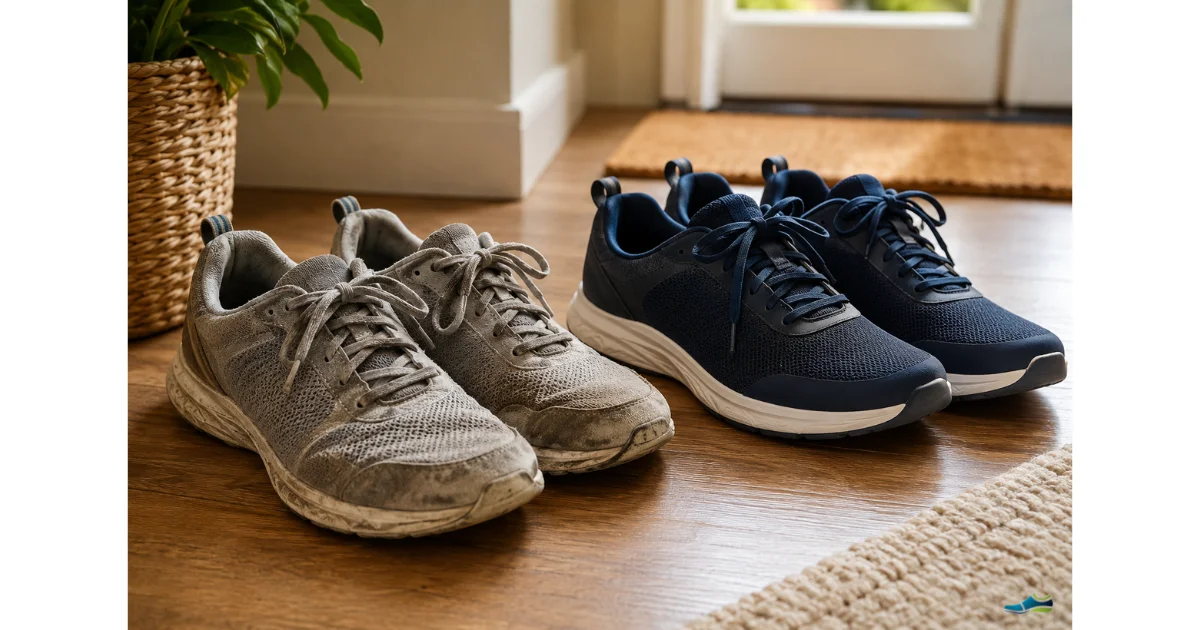
If you’re hoping for a simple answer like “12 months” or “500 miles”, I’m afraid it’s not quite that straightforward.
Some people replace them within six months. Others happily wear them for two years or more.
Exactly how long they last depends on several things, including how often you wear them, the quality of the foam, your body weight and how well the shoes are made.
The truth is, memory foam shoes don’t suddenly wear out overnight. They gradually lose some of the cushioning because the memory foam compresses over time and reduces the support that made them feel so comfortable in the first place.
What surprised me wasn’t how long mine lasted—it was how gradually they changed.
By the time I realised my favourite pair weren’t supporting my feet quite as well, I’d been wearing them almost every day simply because they were so incredibly comfortable.
If you’ve ever wondered how long memory foam shoes really last, or whether yours are beginning to lose their cushioning, let’s have a look at the timeline, and what actually happens.
Rather than watching the calendar, it’s far more useful to recognise the signs that your shoes are no longer giving your feet the support they once did.
Why Memory Foam Shoes Feel So Good
There’s a reason so many people fall in love with memory foam shoes and I completely understand the appeal.
Unlike firmer insoles, memory foam gently moulds to the shape of your feet, spreading pressure more evenly and cushioning each step. If you’ve been standing all day, recovering from surgery, or simply have tired, aching feet, that soft feeling can be a real relief.
Visually, when a lower limb joint exhibits chronic mobility limitations, persistent structural soreness, or visible post-operative tissue changes, these physical indicators are highly consistent with advanced ankle arthritis or surgical recovery cycles.
Following major total ankle replacements or long days navigating hard communal boundaries, the surrounding bone structures require structured pressure distribution. Managing these dynamic recovery updates comfortably typically requires a multi-layered approach to foot care.
While utilising soft memory foam layers provides excellent immediate relief for surface pressure points, choosing footwear engineered with an independent, supportive heel counter and a stable sole remains an essential factor in protecting your alignment and supporting long-term joint rehabilitation safely.
When every step reminds you that your feet have been through a lot, you naturally look for shoes that don’t rub, don’t pinch and don’t make you wince.
Memory foam seemed to tick every box. And for a while… It really did.
💡 Good to Know
The comfort of memory foam isn’t just about softness.
When the foam is new, it gently cushions pressure points and moulds to the shape of your feet. That’s why so many people describe their first pair as feeling like they’re “walking on clouds.”
The important thing to remember is that comfort and long-term support aren’t always the same thing.
So, Why Doesn’t It Stay Like That?
Here’s the part I wish someone had explained to me years ago.
Memory foam is designed to compress under pressure before slowly returning to its original shape. Every step you take squeezes the foam a little before it springs back ready for the next one.
Over time, though, that constant cycle of compression and recovery begins to take its toll.
The foam doesn’t usually fail all at once. Instead, it slowly becomes less resilient. The change is so gradual that many people don’t notice it happening. You simply get used to your shoes feeling slightly different every week until one day you realise they’re no longer giving your feet the same level of comfort they once did.
And that’s where many of us start asking the question that brought us here… So, How Long Should Memory Foam Shoes Last?
Unfortunately, there isn’t a magic number because no two pairs of shoes live the same life. A pair that’s only worn for the weekly supermarket shop will last much longer than a pair that’s worn from breakfast until bedtime every single day.
That’s one of the reasons I think memory foam shoes sometimes get an unfair reputation. They’re often so comfortable that they become our go-to shoes.
The ones we wear for shopping, The ones we slip on to pop into the garden, The ones we wear to work, The ones we choose for almost everything.
Before we know it, these everyday shoes have covered far more miles than any other shoes in the cupboard. It’s hardly surprising they begin to lose some of their cushioning and shock absorption sooner. For many people, a well-made pair will give good comfort for many months, while others may be happy with them for a couple of years. The important thing isn’t trying to predict an exact lifespan.
It’s recognising when the shoes are no longer doing the job your feet need them to do.
What Affects How Long They Last?
Several things influence how quickly memory foam begins to lose its resilience.
How often you wear them – This is probably the biggest factor. If you wear the same pair every day, they’ll naturally wear more quickly than shoes that get a day or two off each week.
The quality of the shoe – Not all memory foam is created equal. Better quality shoes often use denser foams and stronger construction, helping them retain their cushioning for longer.
Your daily routine – Standing for long periods on hard floors places different demands on a shoe than occasional walks around the local park.
Looking after them – Leaving shoes to dry naturally after getting wet and rotating between two pairs where possible can help extend their useful life.
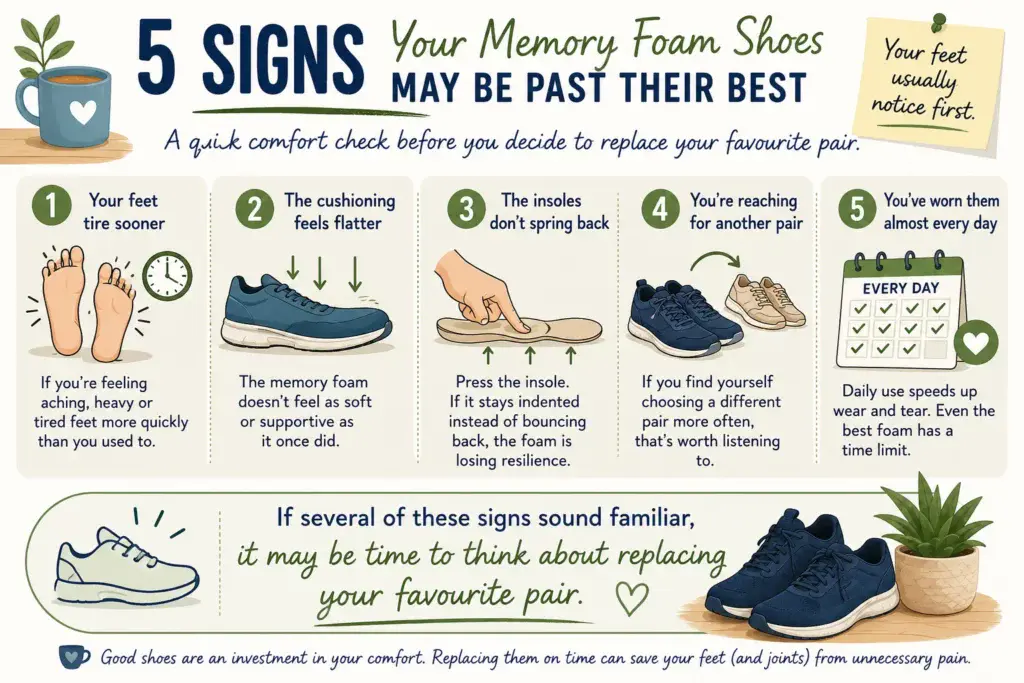
Five Signs Your Memory Foam Shoes May Be Past Their Best
The tricky thing about memory foam shoes is that they don’t usually fall apart overnight. Instead, your feet often notice the changes before your eyes do. Here are some of the signs I would look for.
They Don’t Feel As Comfortable As They Used To
This is usually the first clue. You can’t quite explain what’s changed, but something has. The shoes haven’t suddenly become uncomfortable.
They’ve simply lost that lovely “walking on clouds” feeling you enjoyed when they were new.
Your Feet Feel More Tired At The End Of The Day
If your feet are aching sooner than they used to, it could be a sign that the cushioning isn’t absorbing impact as effectively as it once did.
The Insoles Stay Compressed
Memory foam should recover after you’ve taken your shoes off. If it remains noticeably flattened or doesn’t seem to bounce back as well, it’s telling you that it’s lost some of its resilience.
You’re Beginning To Notice Little Niggles Again
Perhaps your heels are a little sore. Maybe the balls of your feet feel more tender or perhaps you’re simply becoming more aware of the ground beneath your feet. These small changes are often worth paying attention to before they develop into bigger problems.
You Find Yourself Choosing Different Shoes
Sometimes your feet make the decision before your brain does. If you’ve started reaching for another pair because they’re more comfortable, it’s worth asking yourself why. Without realising it, you may already know your memory foam shoes have reached the end of their best days.
When Should You Replace Memory Foam Shoes?
There’s no rule that says you must replace your memory foam shoes after a certain number of months. The real answer is much simpler, don’t just look at the soles. Your feet are usually the first to notice when the cushioning and support have begun to fade.
If the cushioning feels flatter, your feet are becoming more tired, or you’re beginning to notice aches and pains returning, your shoes may have reached the end of their useful life.
Replace them when they’re no longer doing the job your feet need them to do.
What My Favourite Pair Taught Me
I loved my first pair of memory foam trainers. They were wide fitting, had built-in memory foam insoles and fully adjustable laces. I remember thinking, “What more could I possibly want?”
As it turned out… quite a lot.
In fact, I thought they were so good that I bought another pair before the originals had completely worn out. I expected that second pair to feel exactly the same. They didn’t.
They were still comfortable, but somehow I never got that wonderful first impression I’d had with the original pair.
Looking back, I don’t think the shoes had let me down at all. I think I’d simply expected one pair to do the work of several because I’d stopped wearing almost everything else. They’d become my everyday shoes, and by the time I realised they weren’t the same anymore, they’d already given me countless comfortable miles.
Can You Make Memory Foam Shoes Last Longer?
Although no memory foam shoe lasts forever, there are a few simple things you can do to help yours stay comfortable for longer.
One of the best tips is to avoid wearing the same pair every single day. I know that’s easier said than done because memory foam shoes often become favourites. They’re comfortable, easy to slip on and, before you know it, they’re the shoes you reach for every morning.
If you can, try alternating between two pairs. Giving the foam a day to recover between wears may help it spring back more effectively and reduce constant compression.
It also pays to look after them. If your shoes get wet, allow them to dry naturally away from direct heat. Radiators and tumble dryers might seem like a quick fix, but excessive heat can shorten the life of many shoe materials, including the foam inside.
Finally, don’t ignore the little signs your feet are giving you. Most of us try to squeeze every last bit of life out of a favourite pair, but there comes a point where replacing them is actually kinder to your feet than trying to make them last another few months.
Who Are Memory Foam Shoes Best Suited To?
Memory foam shoes can be an excellent choice for many people.
If you spend long hours on your feet, have tired, aching feet after a busy day or simply enjoy a softer feel underfoot, they can make walking much more comfortable.
After my ankle surgery, all I wanted was a shoe that went on easily and didn’t hurt. At that stage of my recovery, comfort mattered more than anything else. However, it’s also worth remembering that memory foam is only one part of a shoe.
A supportive heel, a stable sole, enough width for your feet and the right depth if you wear orthotics are just as important as soft cushioning.
If you wear orthotics or have swelling over the top of your foot, a high volume toe box can often make just as much difference as the cushioning inside the shoe.
That’s why I always encourage people to look at the whole shoe rather than choosing it purely because it contains memory foam. Comfort is wonderful, but it isn’t the whole story. If you’ve ever wondered why one pair of shoes feels better than another, even when they’re the same size, my guide to the benefits of wide fit shoes explains why the overall design of a shoe matters just as much as the cushioning.
Sizing Guidance: Because memory foam inserts take up internal shoe capacity as they warm up, always check the manufacturer’s physical structural width specifications and internal depth scales to confirm the upper shape comfortably handles your unique joint volume.
The Bottom Line
Memory foam shoes don’t suddenly become “flat, or squashed.” They simply change with time. The more you wear them, the more the foam gradually compresses, and eventually the day arrives when they no longer feel quite as supportive as they once did.
For me, the biggest surprise wasn’t discovering that memory foam wears out. It was realising how slowly it happened.
That’s probably the biggest lesson I’ve learnt. If your memory foam shoes have been kind to your feet for months or even years, they’ve done exactly what they were designed to do.
When they eventually lose that lovely cushioned feeling, don’t think of it as a disappointment. Think of it as a sign they’ve earned a well-deserved retirement. Replacing a favourite pair isn’t admitting defeat. Sometimes it’s simply the best thing you can do for your feet.
Frequently Asked Questions
How long do memory foam shoes usually last?
There isn’t a fixed lifespan. It depends on how often you wear them, the quality of the foam, your body weight and the type of activities you do. Many people notice the cushioning gradually becoming less supportive rather than the shoes suddenly wearing out.
Do memory foam shoes lose their cushioning?
Yes. Memory foam slowly compresses with normal use. As it loses resilience, it may no longer provide the same level of cushioning and comfort as when the shoes were new.
Can memory foam recover after being compressed?
When new, memory foam is designed to spring back after each step. As it ages, that recovery becomes less effective, which is why older shoes can begin to feel flatter.
Should I wear memory foam shoes every day?
You can, but wearing the same pair every day will usually shorten their useful life. Rotating between two pairs may help them last longer.
Are memory foam shoes supportive enough for everyone?
Not always. Memory foam can feel wonderfully comfortable, but it’s only one piece of the puzzle. Good arch support, a stable heel, enough depth for orthotics and the right width all have their part to play too.
Medical Disclaimer: The material lifespan parameters, footwear technical configurations, and personal post-surgical observations compiled across this guide are provided strictly for general informational and educational purposes. They do not constitute personalized professional medical advice, clinical diagnosis, or distinct orthopedic rehabilitation routines. Returning joint pain, persistent heel cords soreness, or complex structural changes under the ball of the foot require direct professional assessment and evaluation by a qualified GP, podiatrist, or orthopedic specialist.