
By Sue Holland
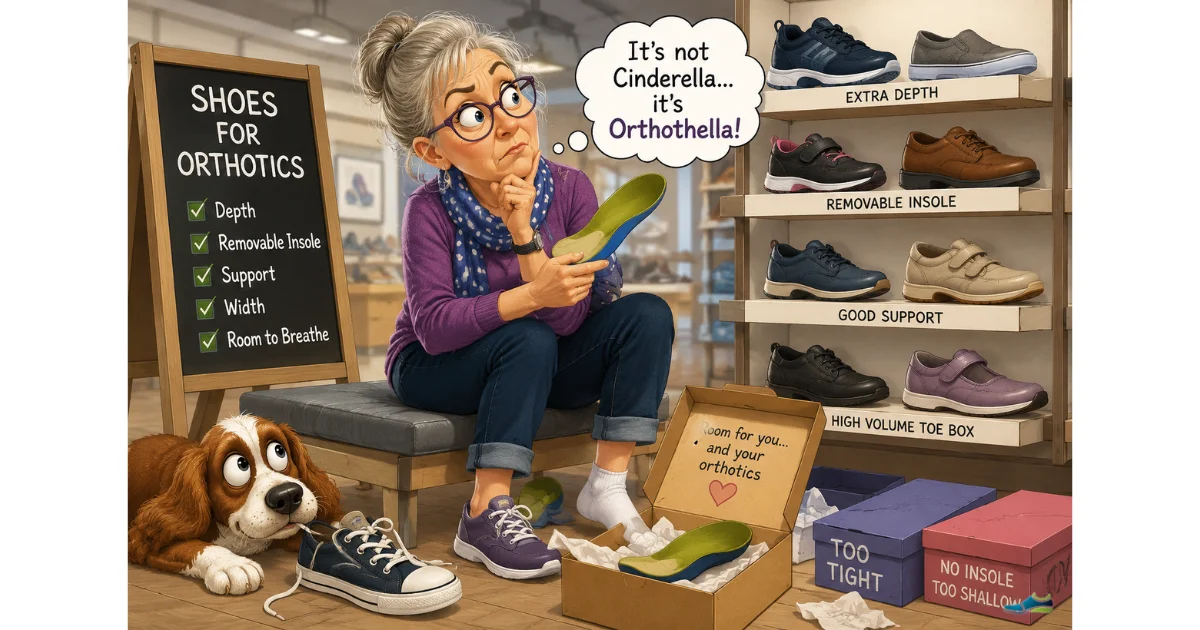
Choosing shoes for orthotics isn’t simply a case of buying a wider fitting or going up a size. The best shoes have enough internal depth, removable insoles, good support and enough room for both your feet and your orthotics to work together comfortably. Get those features right and you’ll usually be far more comfortable. Get them wrong, and even expensive orthotics may never feel as though they’re doing their job properly.
When did you last find a pair of shoes that felt perfect in the shop, only to get home, put your orthotics in and wonder what had happened?
I’ve done exactly the same myself.
After two ankle replacements, arthritis, flat feet and years of swelling, I thought that buying wider shoes would solve the problem. Sometimes they did, but other times the moment I swapped the manufacturer’s insoles for my own orthotics, everything changed. The shoes suddenly felt tighter, my toes rubbed the top, and what had seemed like a comfortable fit became anything but.
Looking back, I realised I’d made the mistake that so many people make. I’d gone shoe shopping without my orthotics. If I’m totally honest, I think it was as much about feeling embarrassed as it was about forgetfulness.
That simple oversight taught me one of the most important lessons I’ve ever learnt about footwear. Choosing shoes for orthotics isn’t really about width at all. It’s about choosing shoes with the right combination of features.
Let’s go through them together.
First Things First – Always Take Your Orthotics Shopping
If you only remember one thing from this article, make it this.
Always try new shoes on with the orthotics you’ll actually be wearing.
It sounds obvious, but it’s surprisingly easy to forget. Most new shoes come with removable insoles already fitted. Those insoles are often much thinner than custom orthotics, so when you replace them at home, your feet suddenly sit higher inside the shoe.
That’s when your feet start telling you something isn’t right. Your toes rub, the top of your foot feels tight and suddenly those comfortable shoes aren’t so comfortable anymore.
Trying shoes on with your orthotics already fitted tells you exactly how they’ll feel in everyday use, rather than giving you a nasty surprise when you get home.
1. Removable Insoles
The best shoes for orthotics almost always have removable insoles.
Taking out the original footbed creates valuable space for your orthotics without making the shoe feel tight. Some insoles lift out easily, while others are glued in and aren’t intended to be removed.
If the insoles won’t come out, that’s often your first warning sign that the shoes may not be suitable.
2. Extra Depth Makes All the Difference
This is one feature that’s often overlooked.
Orthotics don’t just support your feet—they raise them higher inside the shoe.
Without enough internal depth, the top of your foot and your toes can end up pressed against the upper, even if the width feels perfectly comfortable.
Unlike a high volume toe box, which mainly creates extra room around your toes, extra depth shoes provide additional space throughout the entire shoe. It’s particularly useful if you’re wearing full-length orthotics which make your whole foot sit higher inside the shoe.
3. Don’t Forget the Toe Box
Even with extra depth, some people still need more room around their toes.
That’s where a high volume toe box becomes important.
Rather than simply making the shoe wider, it provides more space above your toes. This can make a huge difference if you have hammer toes, swollen feet or simply find that the tops of your toes always seem to rub.
4. Width Still Matters
People often assume orthotics automatically mean buying wider shoes.
Sometimes that’s true.
Sometimes it isn’t.
The width of your shoe still needs to match the width of your foot. Going up a size or choosing an unnecessarily wide fitting can create different problems, including your feet moving around inside the shoe.
The aim is to create enough room for your feet and orthotics without sacrificing stability.
I have a very useful article that may help, The truth about shoe width and why going up a size doesn’t always help.
5. A Supportive Heel Counter
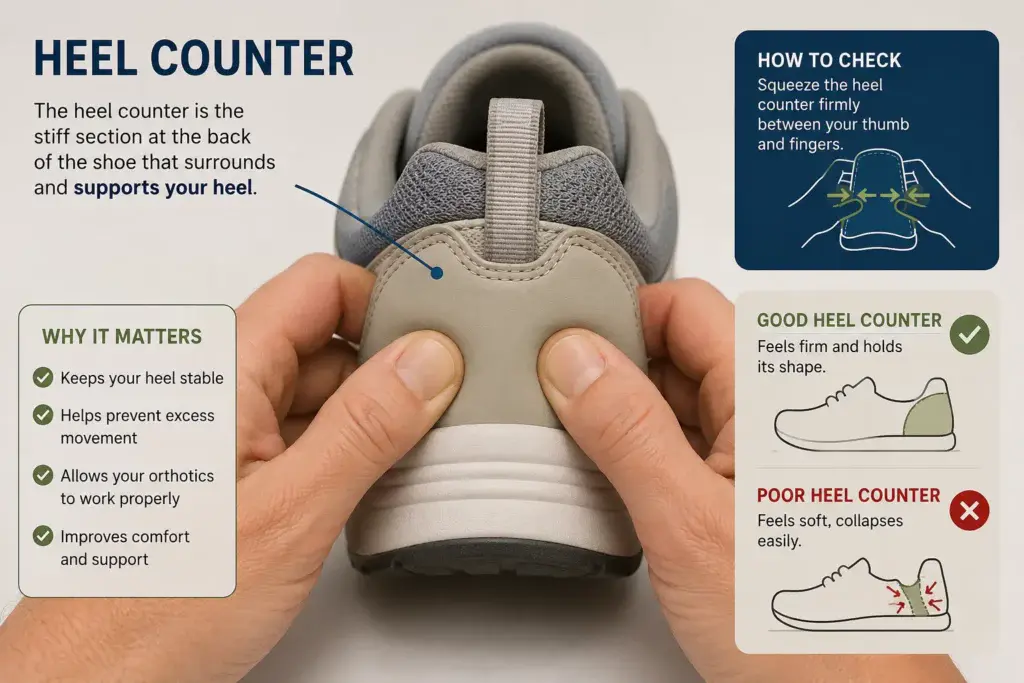
Turn the shoe around and gently squeeze the heel.
If it collapses easily, it probably won’t provide much support.
A firm heel counter helps keep your foot stable while allowing your orthotics to do the job they were designed to do.
6. Adjustable Fastenings
Laces remain my favourite because they allow you to adjust the fit along the whole foot.
Velcro straps can also work well, especially if arthritis makes tying laces difficult and sometimes a combination of both laces and zips are very handy.
The important thing is being able to fine-tune the fit instead of relying on elastic or slip-on shoes.
7. Soft Uppers Can Save Your Feet
Feet change during the day.
Swelling comes and goes, particularly if you’re on your feet for long periods or have arthritis or circulation problems.
Soft leather or stretchy fabric uppers allow the shoe to adapt more comfortably than stiff materials that simply press back but not so soft that the shoe loses the support your orthotics are relying on.
8. Stable Soles
A supportive shoe isn’t just about what happens inside.
The sole plays a huge part too.
Shoes that twist and bend too easily may not provide the stable platform your orthotics need.
A firmer sole often allows both the shoe and your orthotics to work together much more effectively and rocker soles can be an added bonus because they help your foot move through each step more naturally.
9. Don’t Assume Both Feet Are the Same
Many of us have one foot that’s slightly larger than the other, (you’ll already know this if you have had orthotics made)
Mine certainly are.
Always try both shoes on with both orthotics fitted.
The shoe that feels comfortable on one foot may tell a completely different story on the other.
10. Walk Before You Decide
Standing still tells you very little.
Walk around the shop. Don’t let the sales staff rush you into making a decision, take your time.
Go up and down if there’s a slope available.
Pay attention to any rubbing, slipping or pressure points.
If something doesn’t feel quite right after five minutes, it probably won’t feel any better after five hours.
One More Thing I Learnt
This is something that caught me completely by surprise.
Once I started wearing my orthotics properly, I noticed my feet seemed to sit slightly differently inside my shoes. Because the orthotics supported my arches, my feet appeared to become a little shorter. Suddenly, shoes that had always felt the right length seemed a touch too long.
That might sound like a good thing, but it wasn’t.
With a shoe that was slightly too long, my foot could move forwards and backwards as I walked. That meant the arch of my foot wasn’t always sitting over the arch support in the orthotic, and when those two no longer lined up properly, it could become quite uncomfortable.
It’s another reason why it’s worth walking around the shop with your orthotics fitted before making a decision. You’re not just checking that the shoe fits—you’re checking that your foot and your orthotic stay working together as you move.
Common Mistakes People Make
Most problems come down to a few common mistakes.
Buying shoes without taking your orthotics.
Assuming a bigger size will solve everything.
Concentrating on width while forgetting about depth.
Ignoring pressure over the tops of the toes.
Buying shoes because they look good before checking whether they’re actually suitable.
Most of us have made at least one of those mistakes—I know I certainly have.
The Bottom Line
Choosing shoes for orthotics isn’t about finding the widest shoe on the shelf or automatically buying a bigger size.
It’s about finding a shoe that works with your orthotics instead of making you wonder why you bothered having them in the first place and wishing that you could do without them.
Features such as removable insoles, extra depth, a supportive heel counter and a high volume toe box can make all the difference, turning a pair of shoes from uncomfortable to genuinely supportive.
Once you understand what to look for, shopping becomes much less of a guessing game.
And speaking from experience, that’s one lesson worth learning before you spend your hard-earned money and ending up with a wardrobe full of lovely looking shoes that you can’t wear.
FAQs
Q: What type of shoes are best for orthotics?
Shoes with removable insoles, enough internal depth, secure fastenings, a stable sole and a supportive heel counter are usually the most suitable for orthotics.
Q: Do I need to buy wider shoes for orthotics?
Not always. Orthotics take up space inside the shoe, but that does not necessarily mean your feet need extra width. You may need more internal depth instead, particularly if the orthotics raise your whole foot higher inside the shoe.
Q: Should I remove the original insoles before fitting orthotics?
In most cases, yes. Removing the original insoles creates room for the orthotics and helps prevent your feet from sitting too high inside the shoes. Follow any instructions given by your podiatrist or orthotist.
Q: Should I take my orthotics when buying new shoes?
Yes. Always try shoes on with the exact orthotics you intend to wear. This gives you a much more accurate idea of the fit and helps you avoid buying shoes that become too tight once the orthotics are inserted.
Q: Are extra depth shoes the same as wide fit shoes?
No. Wide fit shoes provide additional room across the foot, while extra depth shoes provide more vertical space inside the shoe. Some people need one feature, while others benefit from both.
Q: Why do my toes rub when I wear orthotics?
Orthotics can raise your feet higher inside the shoes, reducing the space above your toes. Shoes with extra depth or a high volume toe box may help reduce that pressure.
Q: Can I put orthotics into slip-on shoes?
Sometimes, but slip-on shoes are often harder to adjust securely. Lace-up shoes, adjustable straps or a combination of laces and zips usually make it easier to keep the foot and orthotic stable.
Q: How can I tell whether a shoe has a supportive heel counter?
Gently squeeze the back of the shoe around the heel. A supportive heel counter should feel reasonably firm and hold its shape rather than collapsing easily.
About Sue
Hi, I’m Sue Holland, and I know how frustrating it can be to find comfortable shoes when your feet do not fit the standard mould.
I write from lived experience. I have had two hip replacements and two ankle replacements, and I live with arthritis, flat feet and chronic swelling. I also wear orthotics, so I know how quickly a pair of shoes that seems comfortable can become too tight once the original insoles are removed and the orthotics are fitted.
That experience inspired me to create WiderFittingShoes.com, where I share straightforward advice, practical tips and honest guidance to help people choose shoes that are comfortable, supportive and genuinely suitable for their feet.
If I can help save you from buying one uncomfortable pair of shoes, then this website has done its job.
Medical Disclaimer
The information on WiderFittingShoes.com is based on my personal experience, independent research and publicly available information. It is intended for general information only and should not replace advice from your GP, podiatrist, orthotist, physiotherapist or any other qualified healthcare professional.
Orthotics are prescribed or recommended for many different reasons, and the right footwear will depend on your feet, your condition and the type of orthotics you use. Always follow the fitting advice provided by the healthcare professional who supplied them.
If your orthotics cause persistent pain, rubbing, numbness, skin damage or increasing discomfort, stop wearing them and seek professional advice.