
The best shoe stretcher for toe box relief depends on where your shoes feel tight. A two-way stretcher is useful for increasing overall width, a toe-box raiser creates extra height above the toes, and a ball-and-ring stretcher targets individual pressure points. For boots, a specialist boot stretcher is usually the most practical option.
I’ve used shoe stretchers extensively over the years, and I’m still surprised by how much difference just a few extra millimetres can make to the comfort of a shoe.
In this guide, I’ll show you the main types I’ve found useful, what each one actually does and what I’d look for before buying one.
Affiliate disclosure: This article contains affiliate links. If you buy something through one of these links, I may earn a small commission at no extra cost to you.
A stretcher can help with a shoe that’s only slightly too tight, but it can’t turn a fundamentally badly fitting shoe into the right one. If you regularly need more room around your toes, my Wide Fit Shoes Guide explains what to look for when buying your next pair.
Why the Toe Box Matters
The toe box is the front part of a shoe that surrounds your toes. It needs enough width, depth and the right shape for your particular foot.
If the toe box is only slightly too tight, even a few extra millimetres can make a noticeable difference. That’s where choosing the right shoe stretcher becomes important. A width stretcher and a toe-box raiser, for example, solve two completely different problems.
I’ve found this particularly useful because my own feet don’t always need more room in the same place. Sometimes it’s width that’s the problem; other times it’s pressure over the top of the toes or one particular spot that’s rubbing.
A shoe stretcher can gradually create a little extra room in suitable footwear, but it has its limits. It’s best for making a small adjustment to an otherwise wearable shoe, rather than trying to completely reshape something that’s fundamentally the wrong size or shape.
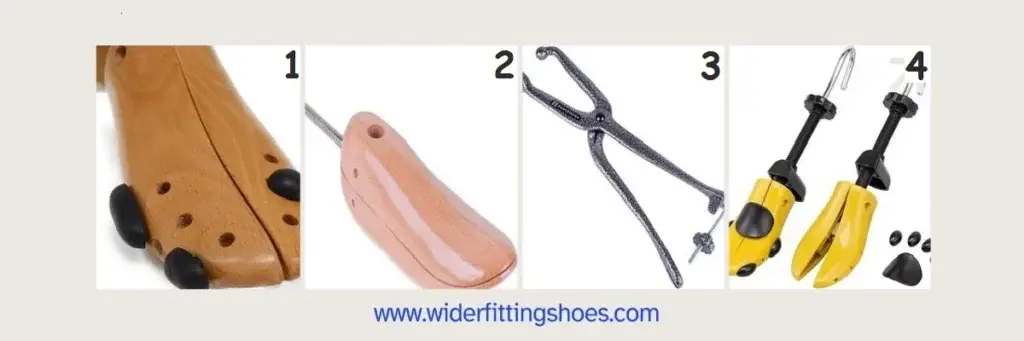
Top 4 Best Shoe Stretchers for the Toe Box
1. Two-Way Shoe Stretcher with Bunion Plugs
A two-way shoe stretcher is the general-purpose option if the front of a shoe feels slightly too narrow. It expands the width and can also add a small amount of length, depending on the design.
Many also have removable pressure-relief plugs. These let you apply extra stretch to one particular spot — useful if a bunion or another prominent area of your foot is rubbing against the shoe.
Best for: Shoes that need a little more overall room across the toes and forefoot, particularly leather shoes that have some capacity to stretch.
- General-purpose width stretching
- Often available in different men’s and women’s sizes
- Many models can be used in either the left or right shoe
A sturdier option worth considering
A lot of inexpensive shoe stretchers are made mainly from plastic, and durability can vary considerably. If you’re going to use one regularly, a more substantial wooden and metal construction may be worth considering.
The Esvioniq wooden shoe stretcher is one example I came across. It has a hardwood and metal construction, includes pressure-relief attachments and is available in several sizes. The package contains one reversible stretcher, rather than a pair, so you’d stretch one shoe at a time.
I haven’t personally used this particular model, so I’m including it as an example rather than recommending it from personal experience. If you’re considering it, check the manufacturer’s size range carefully before ordering.
▶ Check Current Price & Size Options on Amazon UK
2. Toe Box Raiser Stretcher
A toe-box raiser does a different job from a standard width stretcher. Instead of pushing the sides of the shoe apart, it’s designed to create more vertical space above the toes.
This is the type I’d look at if a shoe feels wide enough but the upper presses or rubs against the tops of your toes. It can be particularly useful when you need extra depth because of hammer toes, swollen toe joints or simply a higher-volume forefoot.
I’ve written separately about the FootFitter Toe Box Raiser and also about using a toe-box stretcher for hammer toes if you want to see this type of stretcher in more detail.
Best for: Shoes that have enough width but feel too shallow over the toes, including where hammer toes or swollen joints need extra vertical room.
- Targets height rather than overall width
- Useful for creating a little extra clearance above the toes
- More specialised than a conventional shoe stretcher
▶ Check Availability on Amazon UK
3. Ball and Ring Stretcher
This clever contraption looks more like a blacksmith’s tool than a shoe accessory, but it does a very different job from a conventional shoe stretcher. Instead of widening the whole toe box, it lets you stretch one particular pressure point.
You position the ball inside the shoe where you need the extra room, with the ring on the outside, then gradually tighten the tool to apply pressure to that small area.
Best for: Creating a little extra room at one specific pressure point, such as where a bunion, corn or prominent toe repeatedly rubs against the shoe.
- Durable and metal-based — lasts for years
- Doesn’t stretch entire shoe — highly targeted
- Great addition to a home cobbler kit
▶ Check Current Price on Amazon UK
4. Boot Toe Box Stretchers
Boots can be awkward to stretch because the shaft makes the toe box harder to reach with a standard shoe stretcher. A boot stretcher uses a longer handle or shaft so the stretching mechanism can reach properly into the front of the boot.
If it’s the forefoot or toe-box width that’s tight, look for a model designed to expand that part of the boot rather than one intended to stretch the boot shaft around the calf.
As with ordinary shoe stretchers, some models also include removable plugs for targeting individual pressure points.
Best for: Boots that fit reasonably well overall but need a little extra room through the forefoot or toe box.
- Longer design makes the toe box easier to reach inside boots
- Some models include pressure-relief plugs
- Check that you’re buying a toe/forefoot stretcher rather than a boot-shaft stretcher
▶ Check Boot Stretcher Options on Amazon UK
Tips for Getting the Best Results
- I’ve had the best results by treating shoe stretching as a gradual adjustment rather than trying to force the shoe into shape in one go.
- Take it slowly. Increase the stretch a little at a time and check the fit regularly rather than winding the stretcher as far as it will go.
- Use stretching spray where appropriate. It can help suitable materials become a little more workable. Leather is generally much more accommodating than many synthetic materials.
- Use pressure plugs only where you need them. If one particular spot is rubbing, position the plug carefully rather than stretching areas that already fit comfortably.
- Be particularly careful with delicate or glued footwear. Too much force can distort the shoe or damage seams and joins.
Incidentally, shoe-softening remedies aren’t exactly new. When I was small, my mum used to rub a block of soap inside the heels of my shoes to soften them. I can’t remember owning a shoe stretcher in those days — apparently a bar of soap was sufficient technology.
I’ve also written separately about shoe stretcher spray and when it can be useful.
What Materials Stretch Best?
Leather and suede are generally the most responsive materials for shoe stretching because they have some natural give and can gradually mould to a slightly different shape.
Synthetic materials are much more variable. Some will give a little, while others barely stretch at all or simply return to their original shape once the stretcher is removed.
Canvas and mesh may give slightly under pressure, but they don’t necessarily hold a permanent stretch in the same way as leather.
Whatever the material, make small adjustments rather than forcing it. Be especially careful with delicate shoes, glued seams, decorative finishes or anything that could distort if too much pressure is applied.
The Bottom Line
The most important thing I’ve learned from using shoe stretchers is that there isn’t one “best” type for every tight shoe. You need the stretcher that matches the problem.
If you need more width across the forefoot, I’d look at a two-way stretcher. If the shoe is pressing down on the tops of your toes, a toe-box raiser makes more sense. For one particular pressure point, a ball-and-ring stretcher is much more targeted, while boots may need a longer specialist tool simply to reach the toe box properly.
I own several sets of shoe stretchers, most of them made from cedar with steel components, and I’ve had very good results with them. What still surprises me is how much difference just a few extra millimetres can make to a shoe that was almost comfortable to begin with.
But that word almost matters. A stretcher is brilliant for making a small adjustment to an otherwise suitable shoe. It isn’t a substitute for buying footwear that’s the right basic width, depth and shape for your feet.
If you regularly find yourself needing to stretch new shoes just to make them wearable, my Wide Fit Shoes Guide may help you find a better fit from the start.
Frequently Asked Questions
Q: How much can a shoe stretcher expand the toe box?
It varies considerably depending on the material, construction of the shoe and type of stretcher you’re using. I think of shoe stretching as a way of gaining a small amount of extra room, rather than trying to increase a shoe by a whole size. Make gradual adjustments and check the fit as you go.
Q: Will toe box stretchers damage my shoes?
Yes, they can if they’re overtightened or used on unsuitable materials. Too much pressure can distort the shoe, damage seams or affect glued areas. I always prefer to stretch gradually rather than trying to get all the extra room in one go.
Q: Can I use the same stretcher for both shoes?
Many shoe stretchers are reversible and can be used in either the left or right shoe, although you should check the particular model before buying. If the package contains only one stretcher, you’ll simply need to stretch the shoes one at a time.
Q: Do toe box stretchers work on high heels?
Specialist stretchers are available for some styles of high-heeled shoes, but a standard shoe stretcher may not fit them correctly. Check that the stretcher is designed for the particular style and shape of shoe you want to adjust.
Medical Disclaimer: This article is for general information about footwear and shoe stretching and isn’t medical advice. A shoe stretcher may create extra room around a pressure point, but it doesn’t treat bunions, hammer toes, corns or other foot conditions. If you have persistent foot pain or a foot problem you’re concerned about, seek advice from an appropriate healthcare professional or podiatrist.
About Sue Holland
Sue writes WiderFittingShoes.com from first-hand experience of finding footwear for wide and difficult-to-fit feet. After two hip replacements, two ankle replacements and years of dealing with arthritis, swelling and feet that don’t always behave the same from one day to the next, she shares the practical things she’s learned about shoe fit, width and comfort.