
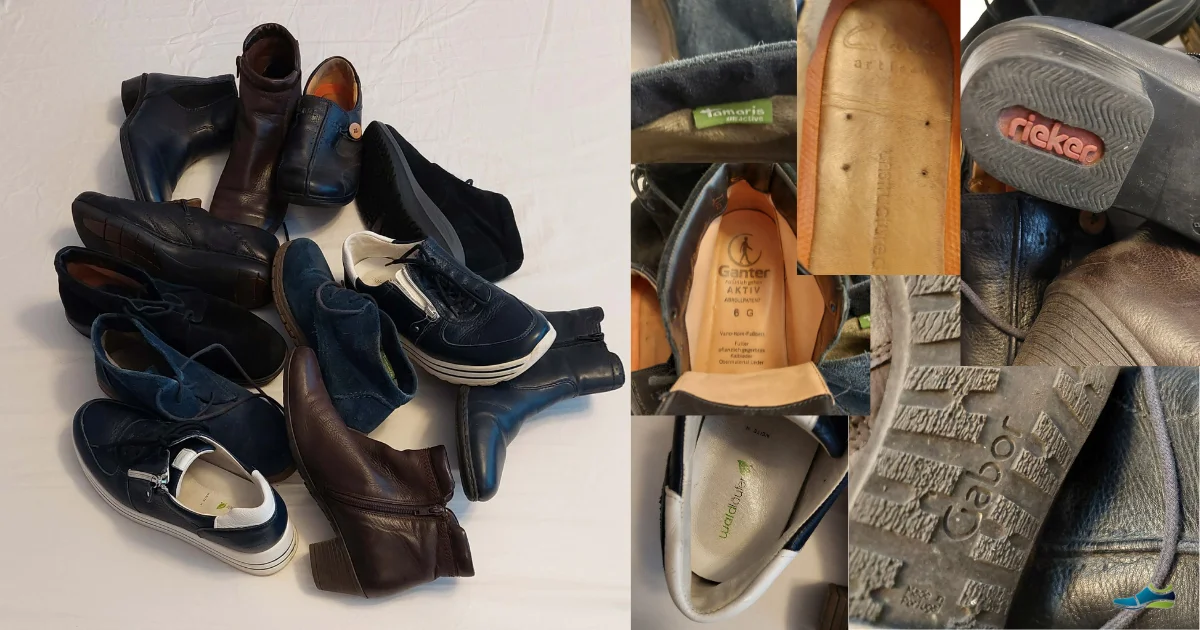
Somewhere along the way, I noticed a pattern in my own wardrobe. The brands I’ve found genuinely suitable for my feet — Tamaris, Rieker, Gabor, Ganter, and Waldläufer — are, without exception, German shoe brands. It wasn’t a decision I made deliberately. It just kept happening, pair after pair, year after year, until I looked at the shoes actually working for me and realised there was a common thread running right through them: they were all German.
Affiliate disclosure: This article contains affiliate links. If you buy something through one of these links, I may earn a small commission at no extra cost to you.
I’m not the only one who’s noticed, either. When I’ve spoken to friends with feet as difficult as mine, the German shoe brands come up again and again, unprompted, with the same kind of quiet loyalty I feel myself.
Why German Shoe Brands Get the Fit Right
I decided to look into why so many German brands kept working for me rather than simply putting it down to coincidence. What stood out was how many of the brands I already wore offered the things I’d learned to look for — different width fittings, roomier shapes, removable insoles and shoes designed with comfort very much in mind.
Of course, being German doesn’t automatically make a shoe comfortable, and British or American certainly doesn’t make one uncomfortable. But when the same handful of German names kept appearing in my own shoe cupboard, I became curious about where they had come from.
The history behind some of these brands helps explain why they kept cropping up.
Ganter began in Waldkirch in 1922, when master shoemaker August Ganter developed a foot-friendly sandal with the help of a doctor. The idea was remarkably familiar to what we talk about on WFS today: shoes shaped around the foot, with enough room for it to move naturally.
Rieker goes back even further, to 1874 in Tuttlingen, Germany, and remarkably, it remains family-owned six generations later.
Gabor has an extraordinary history. The family’s original shoe and leather business was lost during the Second World War, and their parents were killed. In 1949, brothers Bernhard and Joachim Gabor started again in Barmstedt near Hamburg with very little — their first sewing machine was obtained by trading their father’s gold pocket watch for it.
Tamaris belongs to the Wortmann Group, founded by Horst Wortmann in Detmold in 1967. Even the name has a slightly quirky history: company accounts trace it back to Horst Wortmann liking the name Tamara after hearing it in a German television series.
Waldläufer, Gabor, Ganter and Tamaris are very different brands, with different styles and price points, but they keep cropping up in my wardrobe for much the same reason: I’ve found shoes among their ranges that give my feet the space and comfort I need.
Waldläufer remains my own everyday go-to. They offer several width fittings, including G, H, K and M, and removable footbeds are a standard feature across their range — exactly the sort of practical details that matter to me.
Gabor Comfort is another range worth looking at if you need more room, with models available in wider fittings and features such as removable insoles.
If you’re new to German sizing specifically, it’s worth knowing they use a completely different width lettering system — I’ve explained exactly how it works in G, H, K, M: What Do German Shoe Width Letters Actually Mean?
Where I’ve Had to Draw the Line, Even Within a Brand I Trust
I want to be honest here, because blind brand loyalty isn’t really my style, even with brands I genuinely rate. Rieker has been a good fit for my feet for years, but I’ve become increasingly reluctant to buy some of their newer styles because I keep coming across synthetic uppers where I would personally prefer leather.
Rieker still makes genuine leather shoes, so I’m certainly not saying they’ve abandoned leather altogether. But these days I find myself checking the materials before I get too excited about a particular pair.
I completely understand that plenty of people actively want vegan or animal-free footwear, and there’s nothing wrong with that. It just isn’t automatically the best choice for me.
I tend to prefer good leather because of the way it feels, wears and ages, and I’m wary of buying something that may need replacing sooner simply because it was cheaper to make. Perhaps I’m old-fashioned, but I’d rather buy a pair of shoes I love and keep wearing them for years than feel as though footwear has quietly joined the disposable society.
The Exception: Clarks, and One Shoe I Refuse to Let Go Of
Clarks is the odd one out on my list — British, not German, and honestly, most of their current range isn’t for me. But they’ve made some genuinely memorable styles over the years, and one of them earned a permanent place in my life: the Clarks Unstructured Un Loop.
I don’t know a single nurse who didn’t own a pair. Most of my colleagues had the same shoes as me — it was practically a uniform in its own right. Lightweight, genuinely comfortable underfoot, and somehow still smart enough to look properly professional. I still have mine, and I will never get rid of them. When I couldn’t find a new pair recently, I bought a used one instead, because as far as I was concerned, Clarks had discontinued them.
Then I found them! here they are, the Clarks Unstructured Loop
There’s something a little sad about seeing a shoe you’ve relied on for years become harder to find. But it’s also proof that when a brand gets the fundamentals right, it can earn the sort of loyalty that lasts far longer than anyone probably expected.
Mine certainly did.
Why I’ve Had to Learn All This the Hard Way
I came to all of this through necessity, not curiosity. I had my first hip replacement at 48, after eleven years of being undiagnosed — years spent barely able to bear weight, raising young children with very little help, and more visits to osteopaths than I could count.
Feet don’t stay unaffected through something like that. Mine spent over a decade quietly compensating for a joint that wasn’t working properly, and the longer that goes untreated, the more it can seem to snowball into everything else.
I’m proud of how quickly I recovered once I finally had the surgeries I needed — but the years before that taught me more about footwear, through sheer trial and error, than any amount of research ever could have.
So when I tell you these brands have worked for me, it isn’t a guess, and it isn’t marketing. It’s the result of a lot of years, a lot of wrong turns, and a lot of paying close attention to what actually helped.
I’ve told the fuller story of my own shoe journey — including the Ganter sourcing saga in more detail — in Best Wide Fit Shoes for Comfort.
If this resonated with you, I’ve written a much fuller account of everything I learned through my own recovery — including the mistakes, the practical techniques, and the brands I trust — in The Wide Fit Shoe Survival Guide.
About Sue Holland
Sue writes WiderFittingShoes.com from first-hand experience of finding footwear for wide and difficult-to-fit feet. After two hip replacements, two ankle replacements and years of dealing with arthritis, swelling and feet that don’t always behave the same from one day to the next, she shares the practical things she’s learned about shoe fit, width and comfort.
Sources and Further Reading
For the historical information in this article, I referred to the official company histories published by Ganter, Rieker, Gabor and the Wortmann Group (Tamaris).