Yes—but probably not in the way you expect. Wide-fit shoes won’t straighten a hammer toe, but the right pair can make a real difference to comfort by reducing rubbing, pressure and squeezing.
The secret isn’t simply buying wider shoes. It’s finding a shoe with the right width, enough depth and a toe box that gives your toes the space they need.
There’s one question I hear time and time again ……
“When I finally buy a pair of wide fit shoes, will they actually help my hammer toes?”
It’s a fair question because by the time most people ask it, they’re already fed up.
You’ve spent good money on shoes that felt lovely in the shop but became unbearable after an afternoon out. You’ve tried going up a shoe size because someone suggested it would give your toes more room. You’ve even found yourself standing barefoot in the kitchen at the end of the day wondering why something as ordinary as a pair of shoes has become such a battle.
And if that sounds familiar, join the club.
The plus side is that wide-fit shoes can make a real difference to comfort. The downside, if you can call it that, is they don’t work by performing some kind of miracle on your toes. What they do is far more practical, and in everyday life it’s often far more valuable.
So let me explain what I mean.
The biggest surprise isn’t what happens to your toes
It’s what happens to the rest of your day.
When your shoes stop constantly reminding you they’re there, you stop thinking about your feet every few minutes. You can stand chatting to a neighbour without secretly shifting your weight because one toe is rubbing. You can wander around the supermarket without looking for somewhere to sit halfway round, and you can even enjoy a meal out without slipping your shoes off under the table the moment nobody’s looking.
This may not sound life-changing to somebody who’s never struggled with their feet, but if uncomfortable shoes regularly make your feet miserable, these little victories soon add up.
That’s why, for me, the real benefit of a good wide-fit shoe isn’t that it changes your feet. It’s that it can change how your feet feel at the end of the day.
It took me ages to realise that shoe width isn’t the whole answer
For years I thought I was looking for wider shoes. In reality, I was looking for space.
There’s a difference.
Imagine trying to carry home a bunch of flowers in a cardboard tube. You could make the tube longer, but the flowers would still get crushed because the problem isn’t the length. It’s the lack of room that actually matters.
Shoes can be exactly the same.
If the front of the shoe narrows too quickly, your toes are going to end up competing for the same little bit of space no matter what the label says.
The shoes that have always felt best to me are the ones that seem to leave your feet alone. Your toes aren’t being squeezed together, the top of the shoe isn’t constantly reminding you it’s there, and nothing feels as though it’s fighting against the shape of your foot.
Oddly enough, that’s something you notice most when you take those shoes off. Instead of feeling relief, you realise your feet were comfortable all along, and that’s a lovely feeling because it doesn’t happen nearly often enough.
It’s amazing how many people buy longer shoes when what they really need is better-shaped ones
I can understand why.
You try a pair on, your toes feel cramped and the assistant disappears into the stockroom before returning with the next size up. For the first couple of minutes it seems like a good idea. There’s more room in front of your toes, so you assume you’ve solved the problem.
Then you wear them properly.
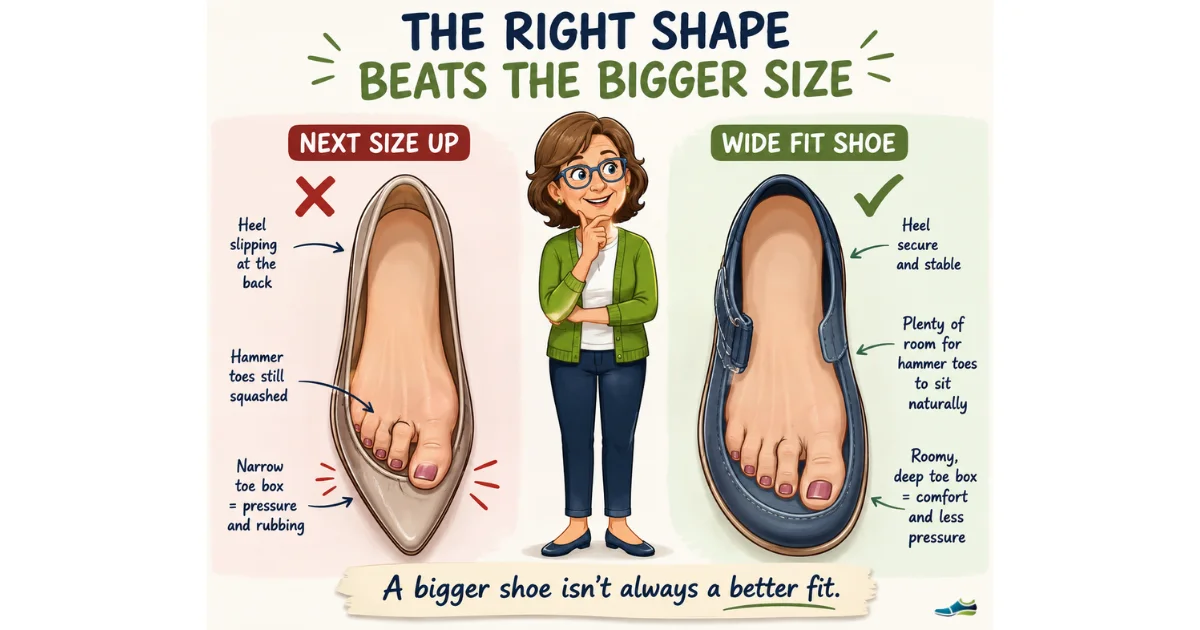
Your heel starts lifting slightly as you walk, you find yourself tightening the laces more than you should, and somehow your toes still don’t feel particularly happy. That’s because nothing important has really changed. The shoe is longer, but the shape around the front of your foot is often almost identical.
It’s exactly the reason I keep coming back to that old trousers comparison. If the waistband’s too tight, buying a pair with longer legs doesn’t fix the issue. All you’ve done is introduce another problem.
Feet deserve the same sort of thinking.
Getting the right length is important, but once you’ve done that, I’d pay just as much attention to how the shoe is built around the forefoot and toes rather than automatically going up another half size.
The aim is to get all three right: length, width and enough depth and shape around the toes.
The toe box deserves far more attention than the size label
If somebody gave me two shoes with the same width fitting and asked me to choose without looking at the label, I’d look at the front of the shoe first.
Not the brand, not the colour and not the price, but the shape.
Some toe boxes are nicely rounded, almost following the natural outline of your foot. Others taper inwards, and you may not realise how much until you’ve been wearing them for an hour or two.
That’s where hammer toes can really make their presence felt, simply because there isn’t enough room around them.
I think that’s one of the reasons people become disappointed with “wide fit” shoes. They understandably expect every wide fitting to feel the same, when in reality, two shoes carrying exactly the same width marking can feel completely different once they’re on your feet.
The label tells part of the story. The shape tells the rest.
Don’t expect perfection – expect progress
I sometimes think we do ourselves a disservice by expecting one purchase to solve everything.
It would be lovely if a new pair of shoes could straighten hammer toes, get rid of every ache and pain, and make walking feel effortless again, but life rarely works like that. What a well-designed wide-fit shoe can do is reduce many of those little annoyances that gradually wear you down during the day.
When your toes aren’t constantly rubbing, when you’re not trying to curl them to avoid pressure, and when you’re not counting the minutes until you can kick your shoes off, you suddenly realise how much energy you’ve been wasting simply coping.
For me, that’s where the real value lies.
After years of struggling to find footwear that suited my feet, I stopped looking for the “perfect” shoes and started looking for the ones that allowed me to forget about my feet for a while. That might only sound like a small ask, but if you’ve lived with sore feet you’ll know it’s actually quite a big one.
There are a few features I never ignore
When I’m looking at shoes now, I don’t get distracted by fancy marketing terms. I’m interested in whether they’re likely to be comfortable after four or five hours, not four or five minutes.
A generous toe box is always high on my list because it gives my toes room to sit naturally instead of competing for space. Soft uppers are a favourite feature because they tend to move with your feet instead of constantly pressing against the joints. If the shoes have adjustable laces or straps, that’s another bonus because our feet aren’t always exactly the same from morning until evening, especially if swelling is part of the picture.
I also like a sole that feels stable and cushioned without going to either extreme. I don’t want something so flimsy I can feel every stone through it, but I don’t want to feel as though I’ve strapped two paving slabs to my feet either. Somewhere in the middle usually feels best for me.
Whatever the label says, I still judge a shoe by how it actually feels on my feet. There should be enough room around the toes without my heel slipping or my foot sliding around inside.
Remember that everybody’s feet are different
One thing I’ve learnt over the years is to be a little cautious when somebody says, “These are the best shoes for hammer toes.”
They might well be the best shoes for them.
Your feet might be wider, flatter, more swollen, or perhaps one foot is larger than the other. You might have arthritis as well as hammer toes, or maybe plantar fasciitis has joined the party too. That’s why I prefer to think in terms of features rather than miracle shoes.
Once you understand what your own feet are asking for, shopping becomes much less frustrating because you’re no longer relying on guesswork.
When is it worth asking for extra help?
If your hammer toes are becoming increasingly painful, causing recurring corns or sores, affecting how you walk or making it difficult to stay active, it’s worth getting professional advice.
A podiatrist can assess what’s happening and advise you about appropriate footwear and treatment options. Better-fitting shoes may still be part of the answer, but they’re not always the whole solution.
If you have diabetes, reduced sensation or circulation problems, it’s particularly important to get advice about any sore or damaged skin rather than trying to deal with it yourself.
The Bottom Line
Wider-fitting shoes won’t straighten a hammer toe, but the right pair can reduce the pressure and rubbing that cramped footwear causes.
The key is not width alone. You need the right length, enough width across the forefoot, enough depth around the toes and a toe box that doesn’t squash everything together.
Get those things right and you’ve got a much better chance of finding shoes you can wear comfortably without being reminded by your feet every five minutes that they’re there.
So if you’ve almost given up on finding comfortable shoes, don’t assume the answer is simply to buy a bigger size.
Sometimes you don’t need a bigger shoe. You just need one that’s a better shape for the feet you’ve already got.
Frequently Asked Questions
Q: Will wide fit shoes help hammer toes?
A: They can help with comfort. A well-fitting wide shoe with enough depth and a roomy toe box can reduce the squeezing, pressure and rubbing around a hammer toe, but it won’t straighten the toe itself.
Q: Are wide fit shoes better than buying a bigger size?
A: If the problem is lack of width or depth, usually. Going up a size gives you extra length, but that doesn’t necessarily create room where you actually need it. The aim is to get the length, width and depth right rather than simply buying a longer shoe.
Q: What features should I look for if I have hammer toes?
A: Look for a roomy toe box with enough depth above the toes, the correct width, soft or forgiving uppers and adjustable fastenings where possible. Above all, nothing should press or rub against the bent toe.
Q: Can the right shoes stop corns forming on hammer toes?
A: Better-fitting shoes can reduce the rubbing and pressure that contribute to corns, but they can’t guarantee that a corn won’t develop. If you keep getting painful or recurring corns, it’s worth asking a podiatrist for advice.
Q: Will hammer toes get worse if I keep wearing tight shoes?
A: Tight or cramped shoes can increase pressure and rubbing around a hammer toe and make it more uncomfortable. Whether the toe itself gets worse over time can depend on several factors, so it isn’t something we can put down to footwear alone.
Q: Should I see a podiatrist if my hammer toes are painful?
A: Yes, particularly if the pain is persistent or getting worse, the toe is changing shape, you’re having difficulty walking, or you keep developing corns or sore skin. If you have diabetes, reduced sensation or circulation problems, get professional advice about any sore or damaged skin.
Medical Disclaimer: This article is for general information only and isn’t a substitute for medical advice, diagnosis or treatment. Footwear may help reduce pressure and rubbing around a hammer toe, but it doesn’t correct the underlying condition. If a toe is painful, changing shape, causing recurring corns or sores, or affecting how you walk — particularly if you have diabetes, reduced sensation or circulation problems — seek advice from an appropriate healthcare professional or podiatrist.
Sources and Further Reading
Royal College of Podiatry – Hammer Toes
About Sue Holland
Sue writes WiderFittingShoes.com from first-hand experience of finding footwear for wide and difficult-to-fit feet. After two hip replacements, two ankle replacements and years of dealing with arthritis, swelling and feet that don’t always behave the same from one day to the next, she shares the practical things she’s learned about shoe fit, width and comfort.